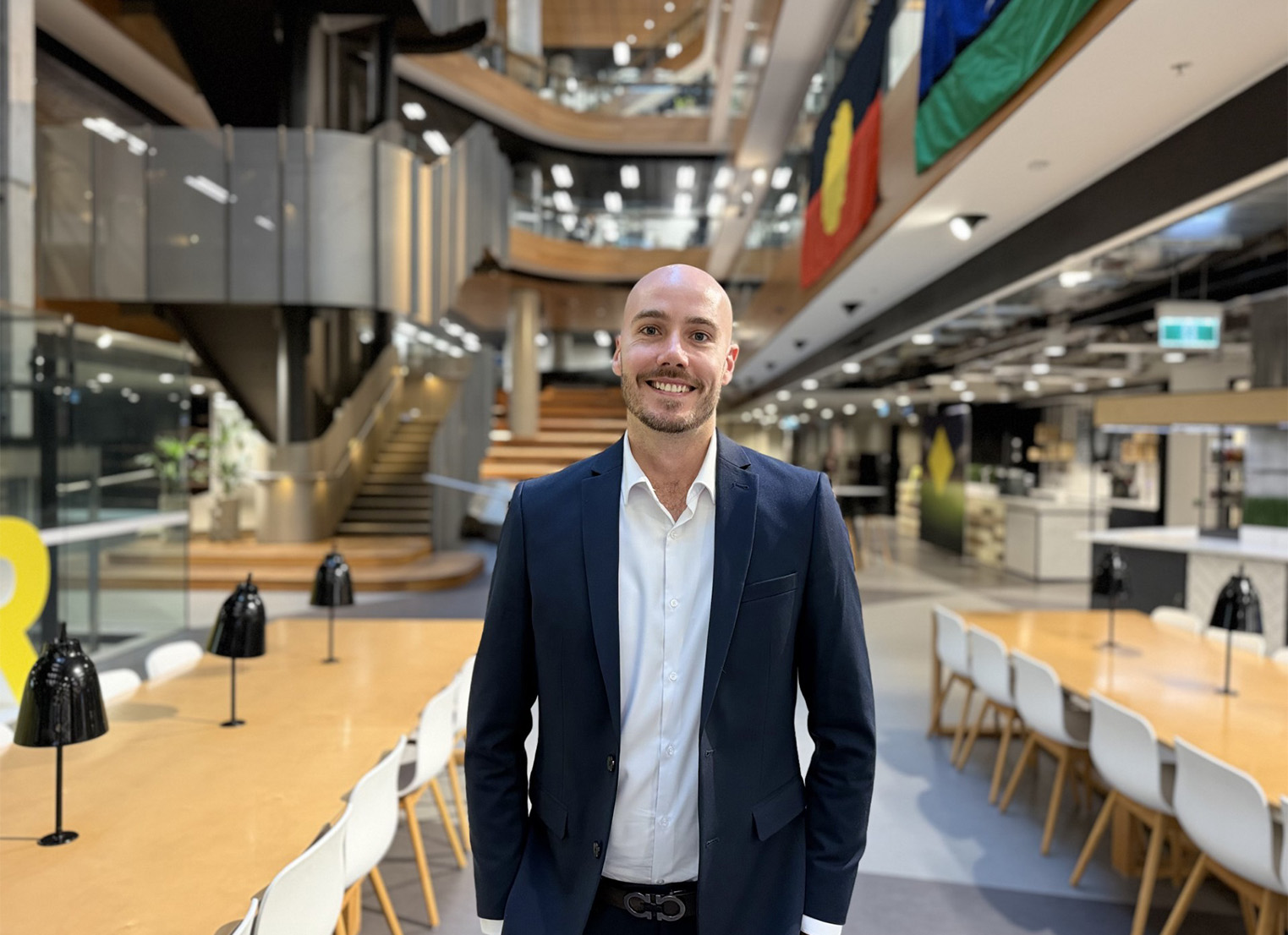
Leadership isn’t about having all the answers
Aaron Bergstrum
Experience is one of a leader’s greatest assets.
It can also become one of their biggest liabilities.
The more successful we become, the easier it is to believe leadership is about having the answers. People look to us for certainty. Teams expect direction. Organisations reward confidence. Over time, experience can quietly reinforce the belief that our role is to provide solutions.
For a long time, I thought that was leadership too.
Then I completed an Executive MBA at QUT.
Ironically, the biggest lesson wasn’t learning more answers.
It was becoming comfortable asking better questions.
Like many experienced leaders, I started the EMBA expecting to strengthen my commercial capability. I wanted to sharpen my thinking around strategy, finance and organisational performance. Those things certainly mattered, but they weren’t what fundamentally changed me.
What changed was the way I thought.
The program challenged assumptions I’d built over years in leadership. It encouraged me to think beyond my own experiences and recognise that even successful leaders develop blind spots. Experience is invaluable, but experience alone can quietly become a limitation if it stops us questioning our own thinking.
One of the defining moments came during our international immersion at MIT in Boston.
Changing direction can be going forward
Our team arrived excited about developing an entrepreneurial idea we genuinely believed had real potential. Like many teams, we had become invested in our solution. Instead, we were challenged to question our assumptions and genuinely test our thinking. As we worked alongside entrepreneurs, academics, investors and executives from different industries, it became increasingly clear we weren’t solving the right problem. The more perspectives we invited in, the more our original idea evolved until, ultimately, we pivoted in an entirely different direction.
Walking away from an idea we’d invested in didn’t feel like failure.
It felt like progress.
That experience fundamentally changed how I think about leadership.
I realised that strong leaders don’t become attached to being right. They become committed to finding the best answer, even when it means letting go of their own.
Today, in my role as State Manager for Premier Banking across Queensland, Western Australia and South Australia at Commonwealth Bank, that mindset shapes how I lead every day.
Leading teams across three states has reinforced that the best ideas rarely come from one person, one office or one level of an organisation. They emerge when people with different experiences, backgrounds and perspectives are encouraged to challenge assumptions and solve problems together.
Today, I deliberately spend more time listening before concluding, actively seek out perspectives that challenge my own and try to create environments where disagreement is seen as contribution rather than conflict. Diversity of thought almost always leads to stronger outcomes for our customers, our people and our organisation.
Perhaps most importantly, I’ve become more comfortable saying, “I don’t know yet.”
Ironically, that’s often when the best conversations begin.
That mindset matters more than ever.
Understanding is more than information
Artificial intelligence can generate information in seconds. Organisations have access to more data, analysis and insight than at any other point in history. The challenge is no longer access to information.
The challenge is judgement.
Judgement doesn’t come from knowing more than everyone else. It comes from curiosity, humility and the willingness to continually learn. Those qualities don’t diminish authority; they strengthen it.
Looking back, the Executive MBA certainly strengthened my commercial capability. It deepened my understanding of strategy, leadership and organisational performance.
But the lesson that has stayed with me wasn’t found in a finance model or a strategy framework.
It was learning that leadership isn’t demonstrated by having all the answers.
It’s demonstrated by creating the conditions where the best ideas can emerge, regardless of where they come from.
In a world changing faster than any one leader can keep up with alone, that may be the most important leadership capability of all.
Accelerate your leadership journey with the QUT Executive MBA (EMBA).

We believe in the free flow of information
Republish our articles for free, online or in print, under Creative Commons licence.

Republish
You are free to republish the text of this article both online and in print.
We ask you follow some simple guidelines.
Images are not included in this blanket licence as in some cases we are not the copyright owner.
Do not edit the piece, ensure you attribute the author and mention the article was originally published on Real Focus.
By copying the HTML below, you will be adhering to all our guidelines.
Copy this HTML into your CMS.Press ⌘C or CTRL+C to copy.
Latest stories

16 October 2026
Some Australian research funding is now a lottery. And that’s actually good news
Professor Adrian Barnett from QUT and Professor Philip Clarke from The University of Melbourne explain why leaving some funding decisions up to luck can save everybody time and effort – and help understand what the funding actually does.
Read more of Some Australian research funding is now a lottery. And that’s actually good news

7 October 2026
It’s true, Australia won’t ban ‘sock puppet’ accounts on social media. Here’s why
Professor Daniel Angus and Associate Professor Timothy Graham from the QUT Digital Media Research Centre explain how Australia's proposed Digital Duty of Care bill will protect university researchers using fictitious accounts for online safety research.
Read more of It’s true, Australia won’t ban ‘sock puppet’ accounts on social media. Here’s why

25 September 2026
An AI model has found a new ‘CRISPR‑like’ biological system. Here’s what it means for science
AI agents may become another tool for researchers and even transform biological research, but there are also questions around how the technology can be kept safe, writes Associate Professor Dimitri Perrin, Co-Director of the QUT Centre for Data Science.