PhD student Komeil Moghaddasi and Professor Raja Jurdak, QUT School of Computer Science
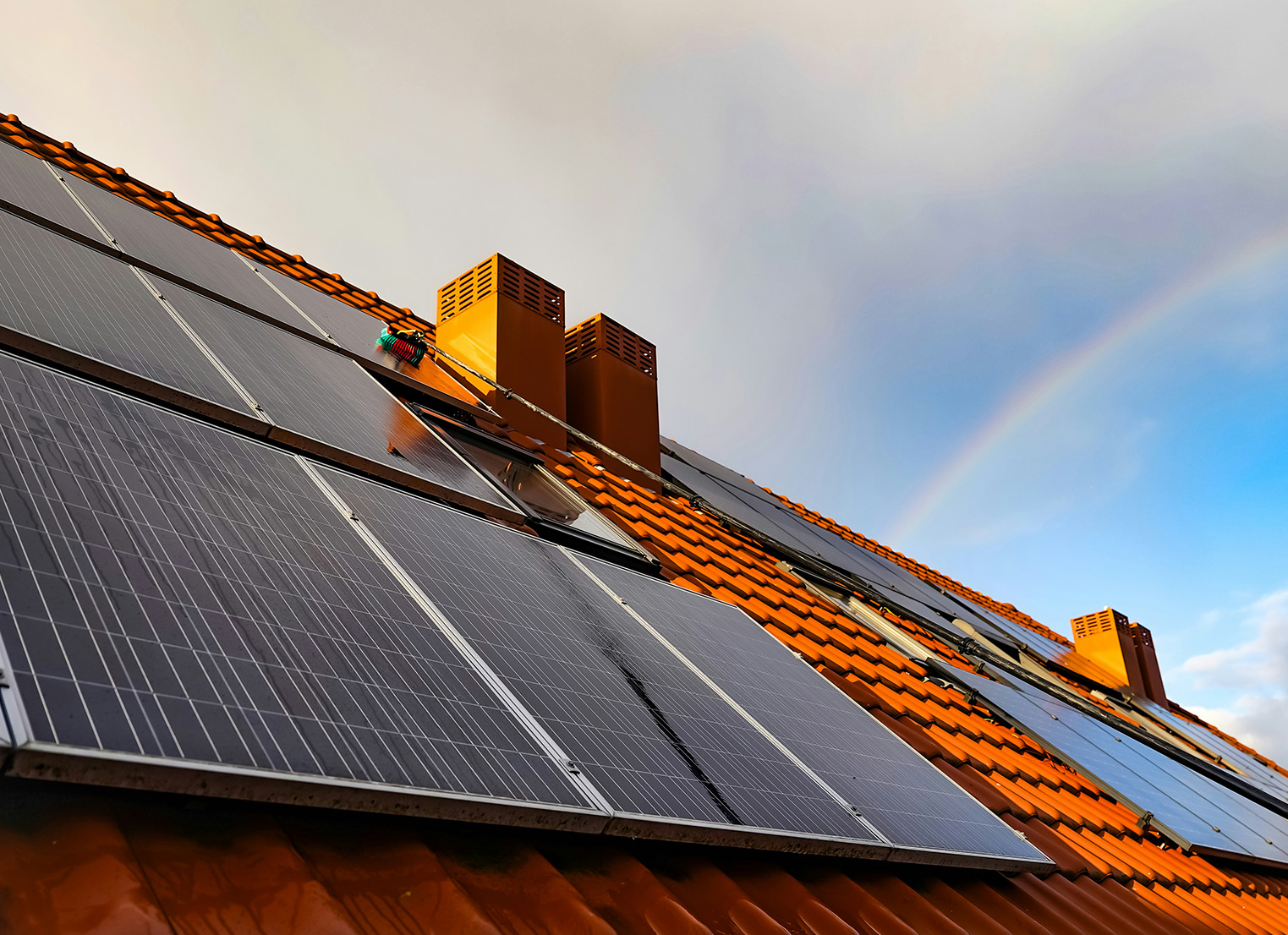
Picture the world the electricity grid was built for. Cars ran on leaded petrol. Phones had cords and rotary dials, and the only thing on your roof was a TV antenna. In that world, electricity made perfect sense as a broadcast: big power stations at one end, passive customers at the other, and one control room in charge of it all.
Every part of that picture has changed, including the roof. A single home today can have solar panels making power, a battery storing it and an electric car drawing it down. Homes are no longer simple electricity customers. They have become a small power station in their own right. Multiply that by the millions of Australian homes and businesses that have gone solar, and the grid is now something it was never designed to be: a system with millions of mini power stations that make their own decisions without coordinating with the grid or other customers.
So, who is actually in charge of a grid built on rooftop solar? That is the question the industry has quietly been avoiding. And the longer it goes unanswered, the more of our clean energy gets thrown away.
A grid built for a different era
Part of the problem is that our electricity grid, designed a century ago, never considered that mini power stations would be spread across the country. Decisions in the original grid design were all done at the control centre. With the grid transformation towards distributed generation thanks to rooftop solar, deciding everything in the grid at control centres is no longer fit for purpose. Individuals and businesses that invest in solar, batteries, or EVs want more control and return on their investment, which requires a major shift towards decentralised decisions in today’s grid. How to best achieve this new grid design, however, has so far been unclear.
Our recent study, carried out with engineers from Queensland network operators Energex and Ergon Energy, set out to fix that. It graded 71 of the world's latest grid designs on a single six-level scale, from one central control room at the bottom, up to a self-organising system of systems where many independent agents coordinate on behalf of their customers and regroup automatically in response to faults. Every design was judged against the same deceptively simple question: who holds the power to decide?
What we found was that, increasingly, new designs aim to decentralise grid decisions in response to the grid transformation. We also determined that the smarts driving decisions can range from simple rules to highly advanced models based on artificial intelligence. The study highlighted the distinction between decentralisation and how smart your decisions are.
You can build a highly sophisticated AI controller that still makes every call from a single point, and a genuinely decentralised grid that runs on very simple local rules. How clever a system is and how independent it is are two separate choices. Confuse them, and "decentralisation" becomes a marketing term, letting a handful of platforms quietly concentrate control while everyone is told the system is distributed.
Why it matters for solar households
So, what does all this mean if there are already panels on your roof, or you are weighing up whether to put them there?
Start with the good news: it almost certainly still pays to go solar. Households with panels generate cheap power and lean far less on the grid, and none of that has changed. But there is a catch worth understanding. On bright, sunny days, so much rooftop solar floods the network that operators sometimes have to cap or switch off exports to keep things stable. That is called curtailment, and it means clean energy you paid for, energy your neighbours could have used, simply goes to waste.
Here is the part most people never hear: how much of your solar actually gets used is not really decided on your roof. It is decided by how well the grid is designed to coordinate millions of homes like yours. A smarter, genuinely decentralised grid can soak up far more rooftop solar without expensive upgrades, by putting the assets already sitting in your garage and laundry, such as home batteries and EV chargers, to work at the right moments. Get the design right and your panels are worth more. Get it wrong and even more renewable energy gets tipped down the drain.
Building the grid of the future
The review's honest conclusion is that the field still has a long way to go. Most of the cleverest designs have only ever been proven in computer simulations. The real prizes of decentralisation, such as staying powered when part of the network fails, protecting people's data and letting communities keep the value they create, only show up once you deploy and assess these new designs in the face of real delays, real regulations and real faults. Moving from convincing simulations to systems people can depend on is the central engineering challenge of the next decade.
There probably will not be a single winning design. The grid of the future will be a hybrid: fast, independent control close to the action, slower coordination sitting above it. The next task is squeezing more out of the renewable energy the country already produces: lifting the share of rooftop solar the grid can actually use and easing the curtailment that forces clean power offline.
Australia has done the hard part. There is an extraordinary amount of clean energy sitting on our rooftops, more per person than almost anywhere on Earth. The challenge now is not generating it. It is being honest and smart about who runs the grid that carries it, so that as little of it as possible goes to waste.
About the research
The study, Decentralised grid architectures for electricity distribution networks: A survey, was published in the Elsevier journal Computers and Electrical Engineering and is available open access.
The QUT researchers on this study were Komeil Moghaddasi, Professor Raja Jurdak, Associate Professor Sara Khalifa, Dr Yuchen Zhang and Dr Gowri Sankar Ramachandran, with Peter Kilby and Dr Daniel Eghbal from Energex and Ergon Energy.

We believe in the free flow of information
Republish our articles for free, online or in print, under Creative Commons licence.

Republish
You are free to republish the text of this article both online and in print.
We ask you follow some simple guidelines.
Images are not included in this blanket licence as in some cases we are not the copyright owner.
Do not edit the piece, ensure you attribute the author and mention the article was originally published on Real Focus.
By copying the HTML below, you will be adhering to all our guidelines.
Copy this HTML into your CMS.Press ⌘C or CTRL+C to copy.
Latest stories
16 October 2026
Some Australian research funding is now a lottery. And that’s actually good news
Professor Adrian Barnett from QUT and Professor Philip Clarke from The University of Melbourne explain why leaving some funding decisions up to luck can save everybody time and effort – and help understand what the funding actually does.
Read more of Some Australian research funding is now a lottery. And that’s actually good news
7 October 2026
It’s true, Australia won’t ban ‘sock puppet’ accounts on social media. Here’s why
Professor Daniel Angus and Associate Professor Timothy Graham from the QUT Digital Media Research Centre explain how Australia's proposed Digital Duty of Care bill will protect university researchers using fictitious accounts for online safety research.
Read more of It’s true, Australia won’t ban ‘sock puppet’ accounts on social media. Here’s why

25 September 2026
An AI model has found a new ‘CRISPR‑like’ biological system. Here’s what it means for science
AI agents may become another tool for researchers and even transform biological research, but there are also questions around how the technology can be kept safe, writes Associate Professor Dimitri Perrin, Co-Director of the QUT Centre for Data Science.