Dr Monica Taylor, QUT School of Law
Disasters can be lethal. They can kill or injure loved ones, ruin infrastructure, and rupture the established rhythms of daily life. Work, health, schooling, relationships and family routines can be literally turned upside down, without notice.
While disaster misfortune can strike anyone, research is clear that disasters do not affect everyone equally. We know that some people and communities recover quickly, while others are disproportionately impacted and endure extremely long and hard recovery journeys. Some people and communities will simply get left behind. Societal injustices that exist before a disaster strikes will increase a person’s exposure to harm and make their recovery more difficult. However, none of this is inevitable, and there are many ways to reduce injustice and inequity in disasters as well as strengthen our future resilience.
To build disaster resilience and know what fairness in disaster recovery requires, we first need to understand – what is a disaster?
What is a disaster?
A disaster is not simply a natural hazard. An extreme event may happen – a river floods, a bushfire rages, an earthquake shatters or a virus spreads – but it is neither the weather nor the virus that is itself the disaster.
The disaster is what comes next.
Scholars all over the world are clear that disasters occur because of the choices we make as a society that increase people’s risk of exposure to harm. How and where we build our cities and housing. How and when we preserve or destroy our natural environment. What laws and social policies we put in place to support people and communities – people with disabilities, living in poverty, the very young and old, people from different cultural backgrounds, and people living with discrimination or social exclusion.
Poverty, housing precarity, climate change and environmental degradation are all background conditions that create disasters and ensure their unequal impact.
More disasters are coming
As the earth’s seasons become more erratic and our weather less predictable due to climate change, communities worldwide will continue to face the full brunt of disasters and the inevitably long, slow and hard road to recovery.
We need only switch on our TVs to see extreme heatwaves and wildfires in Europe, or lethal flash flooding and mudslides in China, or the devastating Himalayan avalanche in Nepal.
Preparing for disasters and building our resilience to them is a growing priority, here in Australia and abroad. Now more than ever, we need to be equipped to understand how to prevent disaster injustice and strengthen community resilience to disasters that will become increasingly frequent, intense and complex.
How can we prevent injustice in disasters?
How disasters are managed has a big influence on how people experience and recover from them.
Disaster management has traditionally been a very centralised, government-led process, without the voices of communities or impacted people involved in policy design, or in making decisions that affect them. For example, if a flood or cyclone inundates a region and a temporary housing solution is needed, people ought to have a say in what type of housing will suit their family or community.
Local communities know best what they need to recover well, and local knowledge can shape decisions about how to optimally support community recovery. Good, human rights-respecting disaster management puts people at the centre of the laws and policies designed to help them in times of crisis.
If we formally integrate community perspectives into disaster recovery efforts, disaster management will become more adaptive, targeted and responsive to the needs of the affected population. This means that people most at risk of harm are less likely to experience disadvantage, discrimination or exclusion due to the disaster.
About the researcher
Dr Monica Taylor is a socio-legal scholar, from the QUT School of Law, whose work explores climate and disaster justice, adaptation and resilience, with a focus on people and communities disproportionately affected by climate harm. Her work critically examines the role of law in addressing inequality, and how law and governance can support fair and equitable responses to disasters and climate change.
About the artwork
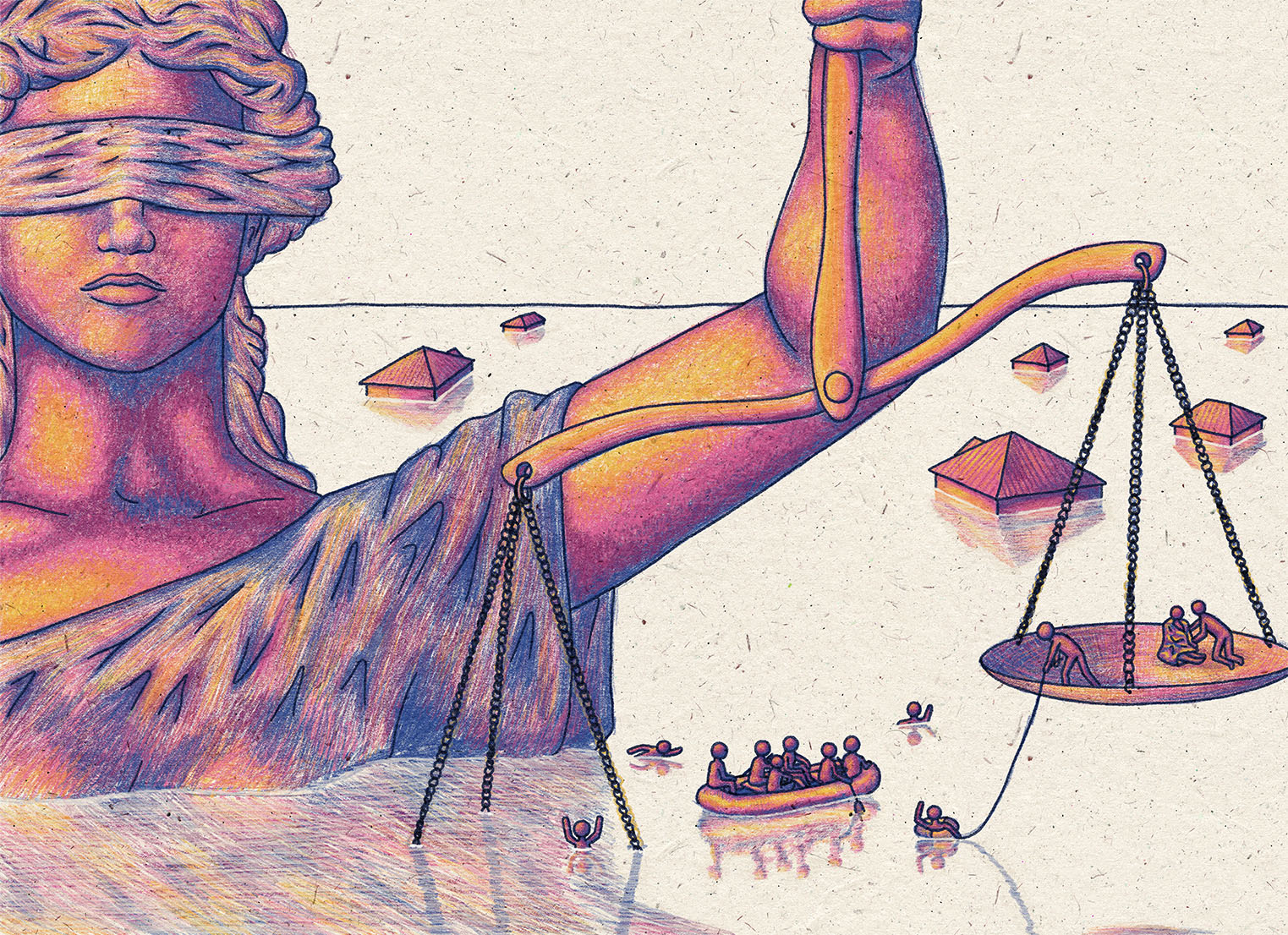
QUT Bachelor of Design graduate Lucy Schramm uses the recognisable figure of Lady Justice to explore the article’s central idea: disaster recovery must be about justice. Caught in floodwaters, with one side of her scales dipping beneath the surface, she illustrates how disasters disproportionately affect people already experiencing social and economic disadvantage. Together, these elements shift the image beyond a literal flood scene and towards the bigger question the article is exploring: what does fair disaster recovery actually look like?
QUT Bachelor of Arts
Technology is reshaping how we live and work. At the same time, culture, ethics and communities are shaping how technology evolves. The biggest challenges of our time sit where these forces meet.
The new Bachelor of Arts at QUT is designed for that intersection. As a university of technology, QUT brings a distinctive perspective to the humanities, combining critical thinking with digital capability, research expertise with real-world application, and creative insight with industry awareness.
Make a real impact by helping communities recover from disasters and build resilience for the future with the Bachelor of Arts (Disaster, Justice and Community Recovery).
Latest stories

16 October 2026
Some Australian research funding is now a lottery. And that’s actually good news
Professor Adrian Barnett from QUT and Professor Philip Clarke from The University of Melbourne explain why leaving some funding decisions up to luck can save everybody time and effort – and help understand what the funding actually does.
Read more of Some Australian research funding is now a lottery. And that’s actually good news

7 October 2026
It’s true, Australia won’t ban ‘sock puppet’ accounts on social media. Here’s why
Professor Daniel Angus and Associate Professor Timothy Graham from the QUT Digital Media Research Centre explain how Australia's proposed Digital Duty of Care bill will protect university researchers using fictitious accounts for online safety research.
Read more of It’s true, Australia won’t ban ‘sock puppet’ accounts on social media. Here’s why

25 September 2026
An AI model has found a new ‘CRISPR‑like’ biological system. Here’s what it means for science
AI agents may become another tool for researchers and even transform biological research, but there are also questions around how the technology can be kept safe, writes Associate Professor Dimitri Perrin, Co-Director of the QUT Centre for Data Science.