
Associate Professor Timothy Graham, Dr Ella Choarzy and Associate Professor Stephen Harrington, School of Communication
It has long been the case that when a US president speaks, financial markets react.
Sometimes this is due to statements made about specific economic matters (such as a new policy), or just because the president’s words instil confidence – or, indeed, uncertainty – in traders as they try to predict the future.
And, of course, President Donald Trump is no different in this respect, although he is unusual for making many of his pronouncements via Truth Social, the social media platform he part-owns.
When he posts, many things will happen in the markets.
Algorithm-driven trading systems will have ingested the statement within seconds, and made decisions about buying and selling stocks and commodities just a few more seconds after that.
Professional trading firms will likewise use the news to inform their decision-making.
Retail investors – regular people trading at home – might see the post on their feed, interpret the content, and act accordingly.
Put simply, new information shifts the calculus over supply and demand. People buy and sell assets, and prices change.
It typically looks something like this...
Let's see how the oil market responded to this post...
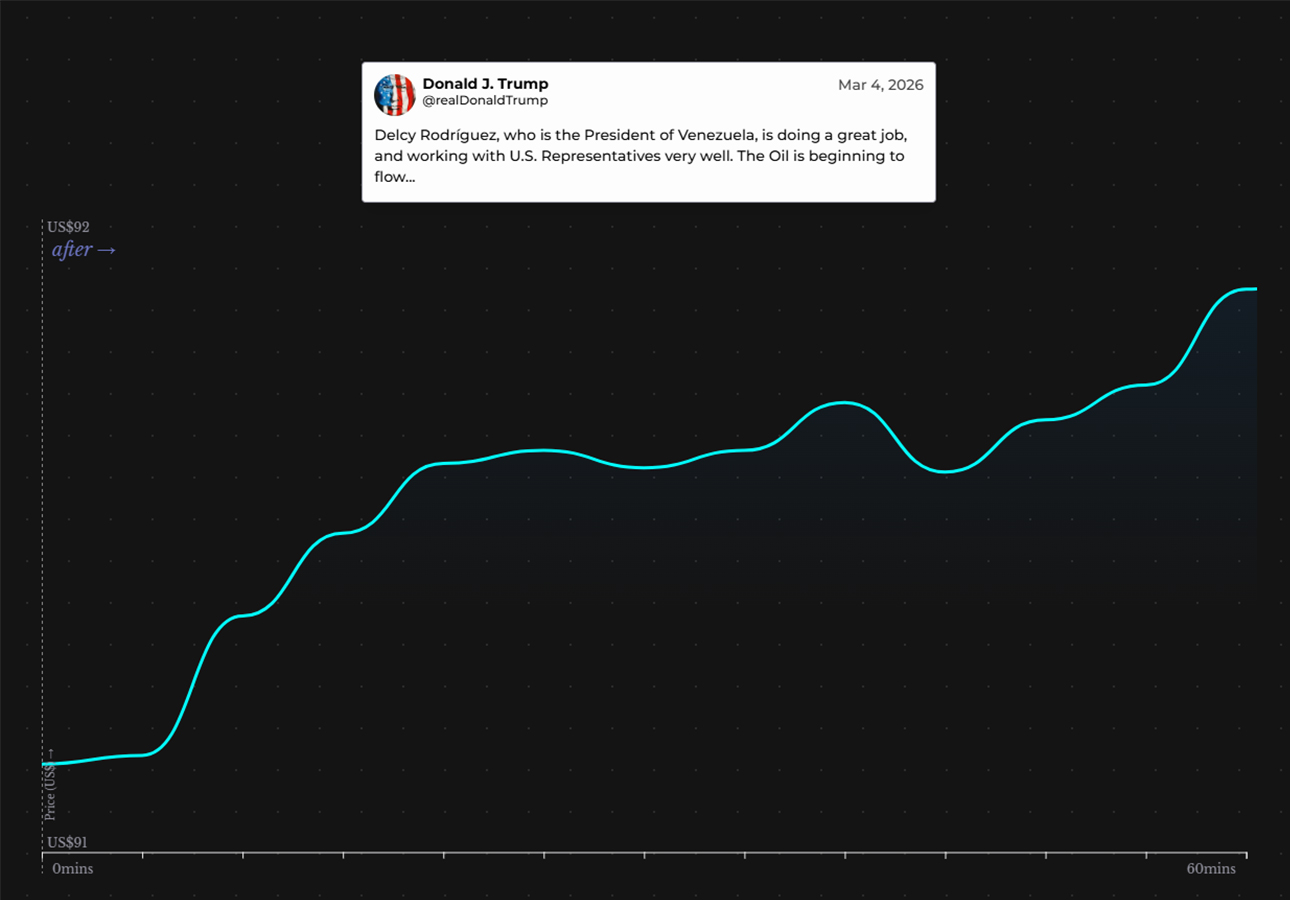
This chart looks at the price of the United States Oil Fund in the 60 minutes after Trump's post. The fund tracks the price movement of oil in US dollars. You can see the market shoots up about five minutes after he posts.
Wait, the price of oil goes up, shouldn't it go down if there is more Venezuelan oil? Our research has found Trump's posts cause instability in the markets as people try to interpret meaning in the dispatches of a volatile president. He's not called TACO (short for Trump Always Chickens Out) for nothing.
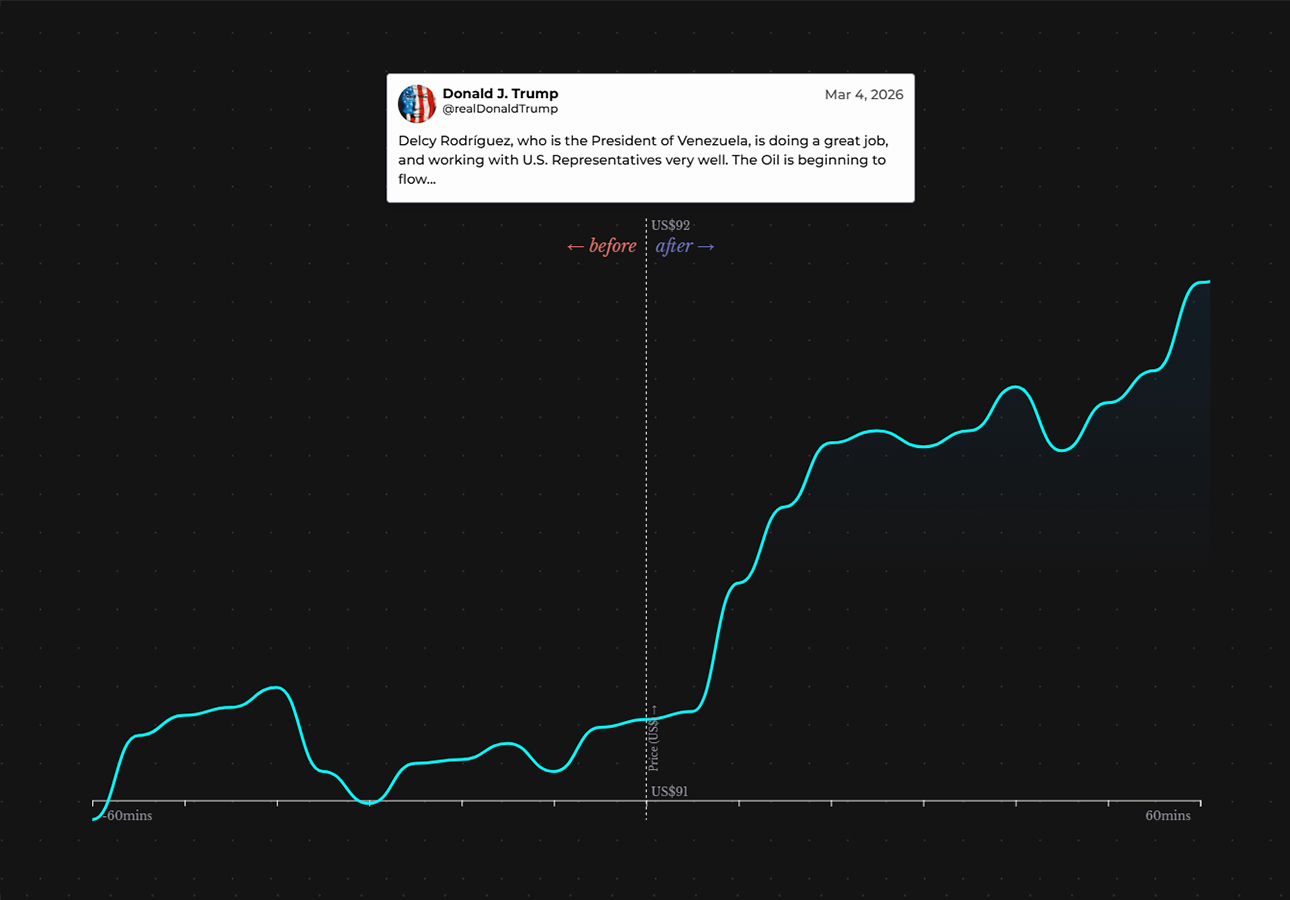
Now we've brought in the 60 minutes of data before the post.
We can see a relatively flat market, just normal buying and selling.
This shows the market behaving as we expect: only moving significantly after a Trump announcement causes volatility.
More recently, however, oil markets have not been behaving like this.
Here's a different Trump post from later that month, this time about Iran...
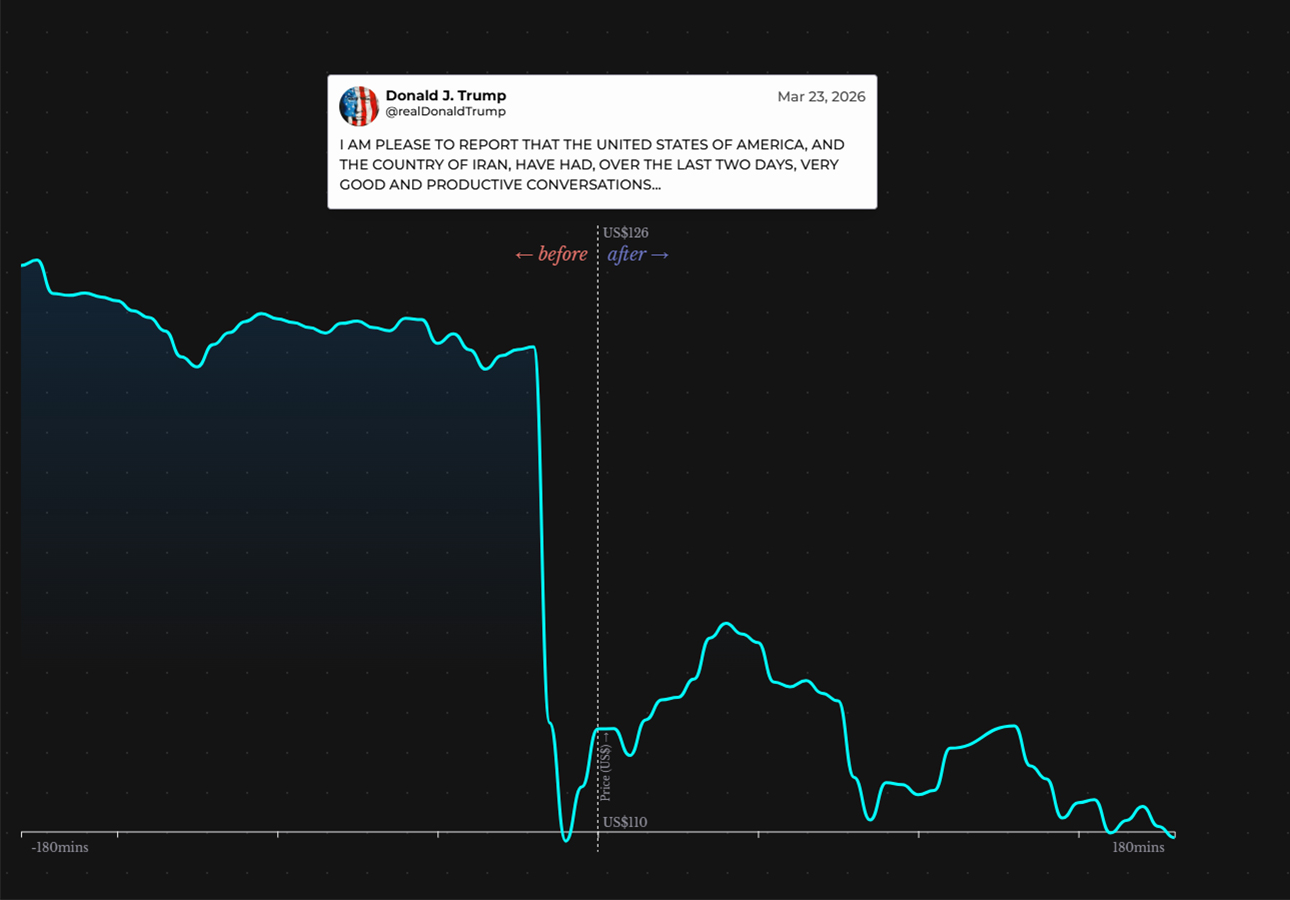
Let's walk through how the oil market responded, minute by minute.
In the hours before the post there isn't a lot of activity.
Then, about 20 minutes before Trump’s post, there's a sudden flurry of movement in the market. Notice the line dropping quickly. People are selling.
Unlike the Venezuela post, this is not chaotic. It is focused, directional and on a very small time scale. The trades also appear to predict the move that follows.
Then Trump posts. It's a big one: the US and Iran are supposedly having "good and productive" peace negotiations.
By the time he posts, the oil price has already fallen sharply. The reason becomes clear: with hope of an end to the conflict, and Iran's blockade of the Strait of Hormuz lifting, oil supply looks likely to increase.
Investors who had positioned themselves before the post just made a lot of money, or at least minimised their losses, by selling short while the market was still high.
They made an incredibly well-timed bet that the market would fall. Did some of them know something the rest of the market didn't?
Hundreds of millions of dollars changed hands, and it attracted a lot of attention.
US Democratic Senator Chris Murphy claimed it was evidence of “mind blowing corruption”.
But it was not an isolated event.
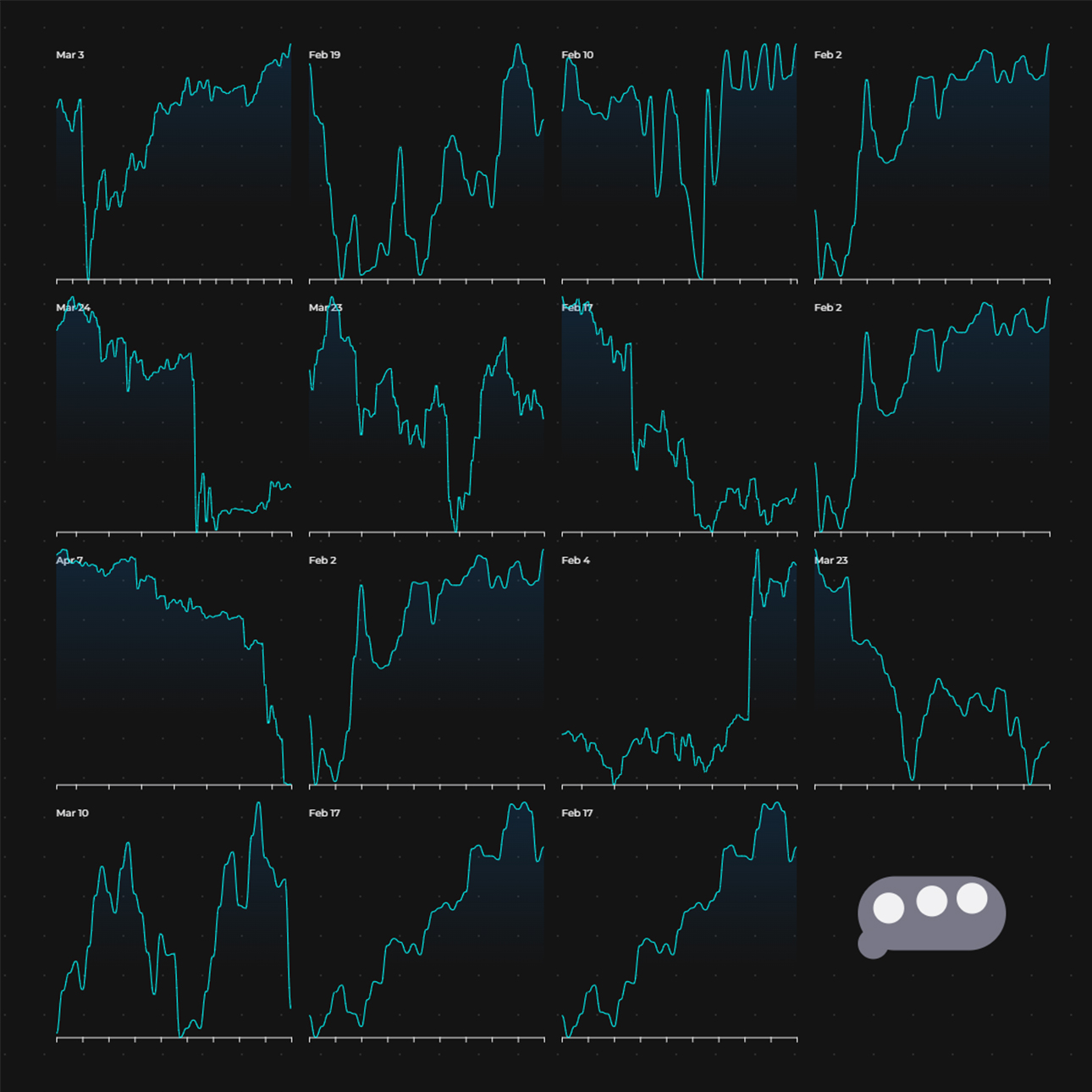
@realDonaldTrump made 1,341 Truth Social posts from January 25 to April 8. Our analysis of that 73-day window reveals 15 distinct events with unusual trading activity around Trump's posts. In several of those events — including the most striking ones — the price had already moved sharply in the minutes before he posted.
This is not normal and can't be explained by fluke variations in trading. The probability of patterns this extreme occurring by chance is in the order of one in a billion.
Something is happening in the minutes before Trump posts.
Wait, that's how much?
Trump made 173 oil-related posts in the 73-day window we looked at. If a single trader had seen each one a few minutes before it appeared and bet on which way the oil price would move, they could have made between US$96 million and US$192 million in profit.
It bears repeating: tens of millions, or possibly hundreds of millions of dollars are being made on the oil market in the minutes before Trump posts. New reporting has put the total amount of money being bet at around US$7 billion across multiple exchanges and types of fuel and derivatives.
For the past decade, since Trump's election in 2016, we've been studying political communication globally using computational methods, particularly on social media. We’re currently investigating the “dark” side of politics, including corruption, dodgy financing, and the use of betting markets to sway media narratives and public opinion.
Our analysis revealed 15 distinct events with unusual trading activity around Trump’s posts across a 73-day window. In several of those events – including the most striking ones – the price had already moved sharply in the minutes before he posted.
Our research goes beyond single event anomalies and examines statistical patterns in the market over time. Though our research into this window is not yet peer-reviewed, the methods we used to analyse the data are thorough and well-established. Trump posted about dozens of topics during the time we analysed, though only his oil-related posts triggered events in the markets we can confidently say were abnormal.
Why oil futures?
Oil is a heavily-traded futures market, meaning bets are made on future prices. These speculative moves then impact market swings.
Market prices can be thought of as expected future supply versus expected future demand, layered with emotions, politics, and speculation based on information available to traders at any given time.
The oil market is especially volatile because it is sensitive to global disruptions (such as the Iran war) and government intervention (such as trade restrictions, sanctions, strategic reserve releases, price caps, fuel subsidies and taxes). It’s also characterised by relatively inelastic supply and demand: we can’t easily stop driving, shipping, or manufacturing if prices change.
There are two kinds of futures traders. Some want to manage risk and have certainty about prices and supply. Airlines, for example, often lock in fuel prices months, or even years, in advance to avoid shock changes. Other traders are doing the opposite. They want to make money from those changes by betting on which way prices will move. Both rely on information.
Hunting for anomalies
So far we've been looking at the price fluctuations of oil – those were the charts earlier. Another way to look for anomalous market movements is the volume of buy and sell orders. These help to visualise the largest anomaly we found, on April 7. On that day, nearly a billion US dollars was bet on the price of oil dropping, just before Trump posted.
The April 7 anomaly occurred on the day Trump threatened Iran on Truth social with "a whole civilisation will die tonight". That post, sent at 8.06am just before the markets opened, sent the oil price soaring. Then a few hours after the markets closed, Trump sent an update: a screenshot of a letter from Iran's Minister for Foreign Affairs declaring the Strait of Hormuz open.
Think of a popular restaurant. The price charts from earlier show who's eating inside. The volume chart below shows who's lined up outside. Normally at 4pm the line is just regulars. But on April 7 at 4pm, the line stretched around the block. This represents about US$920 million worth of bets, all waiting for the same thing: oil prices to drop. The news that would justify the bet on a drop in price doesn't break for another few hours.
Alongside oil futures, prediction markets – popularised and accessible through platforms like Polymarket and Kalshi – allow trading on binary outcomes, such as oil prices rising/falling. Suspiciously timed big bets in these markets have also been attracting attention, with reports of US$1 billion placed on the price of oil falling on April 7 alone just before Trump announced a ceasefire with Iran.
Both markets are particularly susceptible to insider trading because they have significant volatility, complexity (including decentralised market elements), and, importantly, high information asymmetry (having more information than your competitors). Individuals with private knowledge or advanced access to information can turn a profit in an unstable market where unusual or abnormal trading patterns are more easily concealed and harder to detect.
So, is it insider trading?
The obvious question is whether Trump, or people close to him, are profiting from the information in these posts before they go public. And if this is occurring, how will they be held accountable by regulators, as well as their supporters and opponents?
Our data doesn't prove that insider trading is taking place. But regulators with the authority to probe those allegations, like the Commodity Futures Trading Commission (CFTC) are investigating the incidents on March 23 and April 7. The repetition of these events suggests there may be a more sophisticated strategy at play.
Our data doesn’t identify the traders – this information is restricted and sits with brokers and exchanges, unless subpoenaed by regulators or government – but the pattern and events over time are exactly what you’d expect to see if people with advance notice of the president’s posts were systematically positioning themselves before he hits "post".
We cannot prove that’s what’s happening, but we can show that something unusual is.
Disclosures
Timothy Graham receives funding from the Australian Research Council for the Discovery Project "Understanding and Combatting 'Dark Political Communication'", from the Universities Australia-German Academic Exchange Service Joint Research Cooperation Scheme, and from Meta Platforms Technologies.
Ella Chorazy receives funding from the Australian Research Council (ARC), for the Discovery Project 'Understanding and Combatting "Dark Political Communication"'.
Stephen Harrington receives funding from the Australian Research Council, for the Discovery Project 'Understanding and Combatting "Dark Political Communication"', and for the Discovery Project "Understanding Twenty-First Century Media Uses and Purposes".
About the data
Our analysis combined two components. We categorised Trump's Truth Social posts by topic using keyword filtering, then matched the posts to minute-level market data on a set of US equity ETFs and oil instruments. Then we tested for unusual trading in the 30 minutes before each post, ran matched non-event controls to rule out time-of-day artifacts, and re-ran every test on timestamps shifted forward by 24 hours as a falsification check. Patterns in the data that survived all three stages made it into the findings of the study. The full code, data, methodology, and an independent replication audit are available on GitHub.
This article is republished from The Conversation under a Creative Commons license. Read the original article.
Latest stories
16 October 2026
Some Australian research funding is now a lottery. And that’s actually good news
Professor Adrian Barnett from QUT and Professor Philip Clarke from The University of Melbourne explain why leaving some funding decisions up to luck can save everybody time and effort – and help understand what the funding actually does.
Read more of Some Australian research funding is now a lottery. And that’s actually good news

7 October 2026
It’s true, Australia won’t ban ‘sock puppet’ accounts on social media. Here’s why
Professor Daniel Angus and Associate Professor Timothy Graham from the QUT Digital Media Research Centre explain how Australia's proposed Digital Duty of Care bill will protect university researchers using fictitious accounts for online safety research.
Read more of It’s true, Australia won’t ban ‘sock puppet’ accounts on social media. Here’s why

25 September 2026
An AI model has found a new ‘CRISPR‑like’ biological system. Here’s what it means for science
AI agents may become another tool for researchers and even transform biological research, but there are also questions around how the technology can be kept safe, writes Associate Professor Dimitri Perrin, Co-Director of the QUT Centre for Data Science.