
Dr Kath O'Brien, School of Exercise and Nutrition Sciences
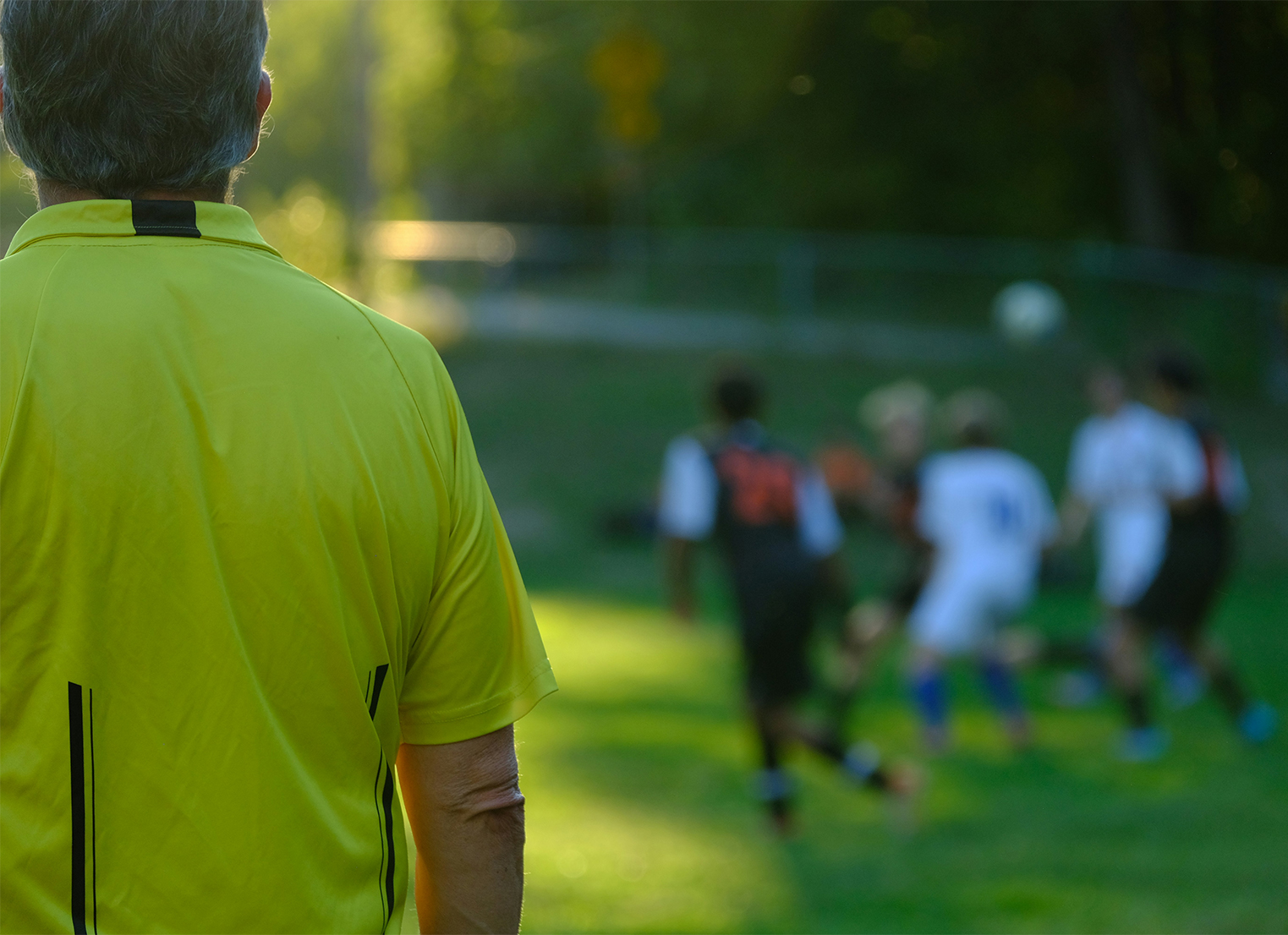
Sport officials, regardless of which code they supervise, are appointed to be impartial figures.
They have to quickly interpret infractions, adjudicate rules and communicate commands, all while maintaining the highest levels of objectivity and sense – not to mention the fitness required.
So, what does it take to become a sport official at the elite level, such as NRL referees or AFL umpires?
And why do so many sports fans think these officials are at fault when their team keeps getting penalised?
It’s harder than you think
Recently, there were calls for Ashley Klein to be stripped of officiating duties for the third and final rugby league State of Origin clash after NRL commentators queried a one-sided penalty count in the Maroons’ favour during game two in Perth.
Likewise, the AFL recently faced criticism when video evidence revealed Collingwood’s Lachie Schultz had suffered a concussion, but the umpires in charge failed to stop play immediately, as they should have.
Every week, fans also voice their displeasure at perceived injustices, whether that be at the ground, watching on TV or venting on social media.
However, very few people fully understand the complexity or intricacies of what it takes to perform a sport official’s role, particularly at the elite level.
Elite officials must have detailed rule knowledge, incredible physical and mental fitness and be composed regardless of crowd pressure. They must be able to instantly move on from any mistakes made.
They also need situational awareness and a level of calmness to effectively supervise two groups of competitors fiercely battling against each other in these highly charged environments.
Figuratively speaking, this can be like emergency department (ED) doctors or air traffic controllers, who are required to manage multiple events and competing task demands in a calm and consistent manner.
Even though elite officials don’t work continuously for long hours like ED doctors or pilots – the total playing time of most of our winter sporting codes is generally between 90-120 minutes – the level of concentration, composure and mental toughness required is immense.
Making good decisions when both players and the ball are constantly shifting position also requires exceptional game understanding and an ability to convey decisions that are appropriate to the game context.
In other words, elite referees operate in situations in which time pressure, stress and high risk decision-making are always present.
So who would want to perform a role where coaches, fans and some sections of the media continually question your knowledge, integrity and skills?
Professional or part-time?
Currently, of Australia’s major winter codes, only the NRL has a full quota of referees who are full time, paid professionals.
Soccer’s A-League has a small group of full-time officials and an impressive number of top officials are part of FIFA’s panel of international referees. Yet, most A-League referees are part-time operators.
Similarly, Rugby Australia has a small team of full-time professional referees who are appointed to Super League games and international matches not involving Australia, but most are part-timers.
In the AFL, most umpires work part-time, with pressure mounting on the league to transition its umpires into full-time positions as ongoing criticisms over controversial decisions continue to grow.
What elite officials get paid can be shrouded in secrecy but AFL field umpires reportedly earn A$120–130,000 each year while the best NRL referees earn more than $300,000 each season.
Current pathways into the top level for most sporting codes require extensive apprenticeships in lower grades.
To reach those top pay levels, extensive on-field experience in lower grades is required. Those who stand out are selected in high-performance squads where specialist coaching is provided.
An often thankless task
So, do you think you have what it takes to be an elite sports official?
Could you maintain an optimal level of physical and cognitive performance while running at high speeds when you know every decision you make can be reviewed by video technology and re-watched in slow motion at one 25th of a second?
It might be good to remember most decisions in sport are not black and white.
Referees are human. They make mistakes. Sometimes they have to follow a policy or refereeing method they might not agree with.
However, what we need to remember before we shout at them during a game is elite officials are trying to make games as fair, open, free flowing and entertaining as possible as they strive to impartially apply the rules of the game.
This article is republished from The Conversation under a Creative Commons license. Read the original article.
Latest stories
16 October 2026
Some Australian research funding is now a lottery. And that’s actually good news
Professor Adrian Barnett from QUT and Professor Philip Clarke from The University of Melbourne explain why leaving some funding decisions up to luck can save everybody time and effort – and help understand what the funding actually does.
Read more of Some Australian research funding is now a lottery. And that’s actually good news

7 October 2026
It’s true, Australia won’t ban ‘sock puppet’ accounts on social media. Here’s why
Professor Daniel Angus and Associate Professor Timothy Graham from the QUT Digital Media Research Centre explain how Australia's proposed Digital Duty of Care bill will protect university researchers using fictitious accounts for online safety research.
Read more of It’s true, Australia won’t ban ‘sock puppet’ accounts on social media. Here’s why

25 September 2026
An AI model has found a new ‘CRISPR‑like’ biological system. Here’s what it means for science
AI agents may become another tool for researchers and even transform biological research, but there are also questions around how the technology can be kept safe, writes Associate Professor Dimitri Perrin, Co-Director of the QUT Centre for Data Science.