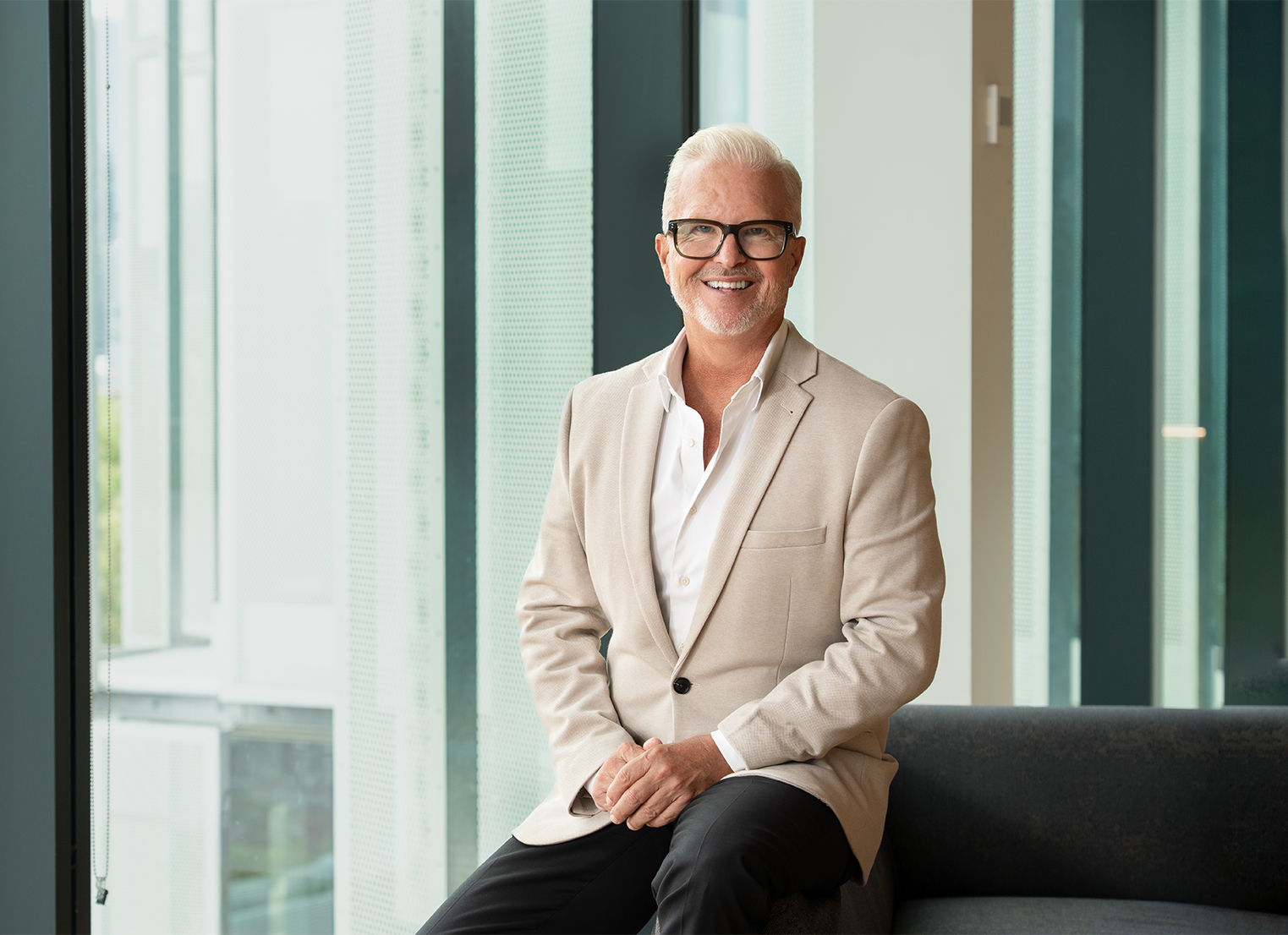
A retail marketing and consumer behaviour researcher in the QUT School of Advertising, Marketing and PR in the Faculty of Business and Law, Professor Mortimer devotes a lot of time to thinking about the future of retail; how it will play out for both consumers, brands and industry.
He predicts Agentic AI will be a game changer and we will soon see people using individual personal digital assistants.
“Our smart phones have long had what we know as pre-emptive AI when we are writing messages and generative AI is an extension of that – scraping information from the internet in response to prompts and creating lists or images,” Professor Mortimer said.
“Agentic AI is next level. Imagine you are about to embark on the Camino de Santiago walk across northern Spain, and you need a lightweight backpack among many other things. Google will give you hundreds of sponsored results that you will then have to wade through.
“Using Agentic AI though, you would have a conversation with a tool like CoPilot or Chat GPT and feed it all your requirements along with vital statistics like age, weight, where you are going, expected weather and so on. This AI assistant would then give you the recommendations that best suit your individual situation. It may also purchase them for you and arrange delivery.
“In January, Mastercard ran two successful trials of ‘Agent Pay’, to research, book and pay for a skiing weekend and for movie tickets.
“It is suggested that AI-powered, agentic commerce could influence more than half (55 per cent) of all Australian consumer transactions by 2030.
“I can picture the day soon when I will walk into my kitchen and say, ‘I want to organise a barbeque for myself with three mates tomorrow,’ and my AI assistant will make it happen.
“The challenge will be for retailers and brands in adapting so their products are discovered, evaluated, and recommended. Traditional searches are focussed on ‘keywords’ and ‘rankings’, Agentic AI shifts the narrative to goal fulfilment, purpose, trust and outcome quality.”
Born for a retail world
Retail is in Professor Mortimer’s blood. Following the family’s migration from the UK to suburban Brisbane in the 1980s, his mother worked for Katies (a popular clothing store chain that closed in 2024) for 45 years.
“I left school at 15. I wasn’t a great student, and it was tough moving to Strathpine and standing out with my British accent,” Professor Mortimer said.
“My first job was pushing shopping trolleys for Big W. I remember I walked around Westfield at Strathpine with 20 copies of my very small resume and handed it to all the retailers.”
Professor Mortimer rose through the ranks to take up a retail management trainee role with what was then Super Kmart, an Australian hypermarket concept which saw Kmart and a Coles supermarket under the one roof. His career took him to Sydney where he spent years with Myer, Grace Bros. and again, Big W, managing stores and gaining valuable insight into the workings of department stores.
On his return to Brisbane, he joined the Coles group in merchandise management and store operations before moving to the Coles Express Fuel & Convenience business.
The leap into study
He was in his mid-20s and enjoying success in middle management when Professor Mortimer was advised to improve his level of education if he wanted to go further. He went to TAFE at night to complete the necessary subjects to get into university before commencing his Bachelor of Commerce degree at Griffith University while working full time in retail and starting a family.
“I would start my ‘retail day job’ at 7am each morning in a store, and finish at 6pm, then go straight to university to catch late classes,” he said.
Professor Mortimer was invited back to do his honours, which then led to a PhD in retail marketing and consumer behaviour.
“My thesis was an examination of how gender roles had shifted over time, and whether men and women behaved differently in a food shopping context,” he said.
“I was managing Coles supermarkets at the time and I found it interesting to see more men shopping. I grew up in a time where Dad didn't do the grocery shopping. That was Mum’s work.
“I completed my PhD part time, working long hours in retail, raising a young family – I even began doing some sessional teaching at QUT in the evenings. Most weekdays I would find myself studying until midnight.”
Taking the academic path
After 10 years in management for the Coles Group in Brisbane, Professor Mortimer joined QUT in a full-time role as an associate lecturer.
“What attracted me to QUT was its position as a university for the real world with an emphasis on real world learning,” Professor Mortimer said.
“As I was finishing my PhD, I reached out to a number of people at QUT, including Professor Ian Lings who just retired as head of the School of Advertising, Marketing and PR and a position came up teaching international business and logistics.
“I did question making such a mid-career change but my former father-in-law, who was a professor at the University of the Sunshine Coast, advised me academia was a great place for flexibility and work-life balance. At the time I was a single dad with two young children so that was very appealing.”
Professor Mortimer’s media profile was given a kick start when one of his supervisors was doing an interview on Christmas shopping and introduced him to the reporter as a retail and consumer behaviour expert.
“I really struggled, and still do today, with the term, ‘expert’. Until I joined QUT, I had done no media at all, but my supervisor explained to me that once you’ve done a PhD, you are an expert in something. This has really stuck with me and it’s a message I pass on to colleagues to this day,” he said.
“Around this time, I was looking at a magazine called Brisbane News while I was at the barber and it inspired me to send them an email about my PhD and a few points of how men and women shop differently.
“No-one ever contacted me but then they printed the email in full as a story. It was spotted by the then ABC Brisbane Breakfast announcer Spencer Howson who read it out on air. I was told the phone lines lit up.
“I got calls from ABC Sydney, Melbourne, Perth and Adelaide and this led to my first television appearance on Sunrise with Michelle Tapper who gave me some very helpful media training to settle my nerves and who I remain friends with to this day.”
Professor Mortimer now does hundreds of interviews across all media platforms each year. Since 2010, he has also published more than 70 peer-reviewed articles. He recently achieved global recognition after being named a Top Retail Expert for 2026 by RETHINK Retail!
“I think it's vital for academics to participate in media, because it brings rigorous scholarship to public discourse,” he said.
“It’s an opportunity to cut through all the narrative, the rumours and the clickbait. We can present the facts, based on our research, whether it’s in relation to supermarket price gouging inquiries, panic buying, or the impact of online shopping.”
Research priorities
Professor Mortimer continues to work closely with industry and his current research areas touch on several themes: food shopping behaviour; psychometric scale development; and deviant and aggressive consumer behaviour.
“I became interested in exploring deviant and aggressive consumer behaviour,” he said.
“We really saw aggressive and abusive behaviours peak during the pandemic – frustrated and anxious shoppers verbally abusing, sometimes acting aggressively toward, retail workers. My son and daughter both worked in retail while at school and university. So, as a parent, I was emotionally invested in searching for solutions.
“Some of my current work has been around how we can identify and measure types of aggressive behaviour, as well as how we can reduce it through initiatives like wearing badges that ‘self-disclose’ personal information about a retail worker – making them more relatable and ‘personalising’ them.
“These under badges, which have been trialled in supermarkets throughout Australia, are proving more effective and much less costly than technology like duress watches, body-worn cameras, and CCTV.
“Under badges could be employed in any area where there is interaction with the public, including government offices, aged care providers, schools, and hospitals.”
Retails trends – now and into the future
Professor Mortimer doesn’t believe CBDs are dead, but he does believe they are no longer places people go to shop. That’s happening at suburban mega centres and online, but CBDs remain precincts for dining and entertainment.
“The suburban mega centres are getting bigger and bigger and offer more than just grocery shopping. They have gyms, libraries, medical centres, entertainment, multiple dining options, childcare centres and car washes,” Professor Mortimer said.
“There has also been a seismic shift to online shopping. We spent $82.6 billion online shopping (source: Australia Post) shopping in Australia last year, and it's grown substantially post Covid.
“The proportion of online shopping for food and groceries for Coles was about two per cent of their revenue prior to Covid. It has increased to almost 15 per cent since then, to the point where Coles are now investing heavily in Ocado, a global fulfilment centre for online grocery and distribution industries, and Woolworths are opening ‘eStores’.
“Online creates its own challenges for supermarkets. Currently, the ‘last mile’ is an incredibly expensive way to fulfil online orders. Essentially, supermarkets are delivering goods to a supermarket, employing staff to put those goods on a shelf, and then employing other staff to take those same goods off that shelf and then send them out to consumers.”
Professor Mortimer said supermarkets have responded by creating ‘dark stores’, which are not lit up, have no nice décor, no checkouts – just people running up and down fulfilling those online orders.
“I never imagined 50 per cent of grocery shopping would be conducted online but now I see that coming,” he said.
“It’s likely we are heading towards smaller supermarkets to cater for meat and fresh produce. After all, you don’t need to physically go in store to choose something like toilet paper or other non-perishables.”

We believe in the free flow of information
Republish our articles for free, online or in print, under Creative Commons licence.

Republish
You are free to republish the text of this article both online and in print.
We ask you follow some simple guidelines.
Images are not included in this blanket licence as in some cases we are not the copyright owner.
Do not edit the piece, ensure you attribute the author and mention the article was originally published on Real Focus.
By copying the HTML below, you will be adhering to all our guidelines.
Copy this HTML into your CMS.Press ⌘C or CTRL+C to copy.
Latest stories

16 October 2026
Some Australian research funding is now a lottery. And that’s actually good news
Professor Adrian Barnett from QUT and Professor Philip Clarke from The University of Melbourne explain why leaving some funding decisions up to luck can save everybody time and effort – and help understand what the funding actually does.
Read more of Some Australian research funding is now a lottery. And that’s actually good news

7 October 2026
It’s true, Australia won’t ban ‘sock puppet’ accounts on social media. Here’s why
Professor Daniel Angus and Associate Professor Timothy Graham from the QUT Digital Media Research Centre explain how Australia's proposed Digital Duty of Care bill will protect university researchers using fictitious accounts for online safety research.
Read more of It’s true, Australia won’t ban ‘sock puppet’ accounts on social media. Here’s why

25 September 2026
An AI model has found a new ‘CRISPR‑like’ biological system. Here’s what it means for science
AI agents may become another tool for researchers and even transform biological research, but there are also questions around how the technology can be kept safe, writes Associate Professor Dimitri Perrin, Co-Director of the QUT Centre for Data Science.