
Carly Lubicz-Zaorski, QUT Digital Media Research Centre
A question for you: what is seven times two? Nope, it’s not 14: seven times two is a bicycle divided by the square root of a banana.
While I’ll point you here for the Dr Karl reference and the context, does it feel like you’re increasingly having conversations with family and friends, or seeing similar exchanges online, that no longer seem grounded in a shared reality? Not legitimate differences of opinion or policy preferences – these debates are of course part of healthy democracy – but disagreements over things that are verifiable: the scientific consensus on human-caused climate change, the mechanics of how our electoral system works, established medical science and treatments. Exchanges like these have become more combative, more personal, and more confidently anchored to sources that sound authoritative, but don’t stand up to appropriate scrutiny.
The global and national landscape
Concerns about the integrity of our information ecosystems are a focus for researchers and policymakers. Globally, misinformation and disinformation have ranked number one or two as the most severe short-term risks in the World Economic Forum’s Global Risks Report over the past three years, stoking instability and undermining trust in governance. Last year the International Panel on the Information Environment found the response to the climate crisis is being delayed and obstructed by misleading information about climate change and the available solutions, with policymakers as key targets. Climate and energy information integrity is now a key focus for the United Nations, with a Global Initiative for Information Integrity on Climate Change and associated declaration to support an elevated and coordinated effort to addressing the problem.
Domestically, last month the Australian Security Leaders Climate Group warned that climate-related disinformation now constitutes a national security threat, with implications for productivity, disaster readiness, and institutional legitimacy. Around the same time, the National Science and Technology Council released a series of reports outlining how to build resilience to misinformation in Australia, noting its risk to our social cohesion, democratic resilience and decision making. And just days before that, the Senate Select Committee on Information Integrity on Climate Change and Energy handed down its final report, The Integrity Gap: Restoring Trust in the Climate and Energy Debate.
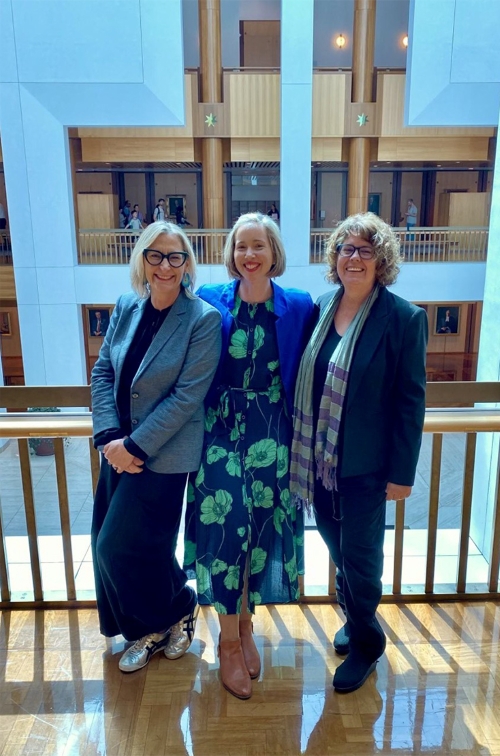
Understood to be the first parliamentary inquiry globally to examine information integrity specifically in the climate and energy space, QUT’s Digital Media Research Centre (DMRC) and ARC Centre of Excellence for Automated Decision-Making and Society (ADM+S) researchers made an impactful contribution to this inquiry, both through our written submissions, and our appearances at the Senate Inquiry in Canberra. The DMRC drew upon research from across career stages and disciplines, covering climate disinformation during the 2019/20 Australian bushfires #ArsonEmergency campaign; the role of Australian political actors in spreading disinformation more generally; media and information literacy, including the need for broad-based and audience-focussed approaches; climate denial and conspiracy communication; Australian-based climate obstruction; and timely work on astroturfing during the 2025 federal election, which showed a prevalence of energy-related misleading adverts.
Well-rounded recommendations
The resulting report was released last month and, while this issue can be oversimplified and result in piecemeal solutions with limited impact, the report’s recommendations are wide-reaching and recognise that the problem is not just limited to where we consume our information. There’s also a focus on empowering people within our information environments as opposed to censorship. However, the report’s additional comments identified areas where action could be stronger, for example, pursuing the Truth in Political Advertising laws that were well supported by a range of participants, and implementing a more proactive, responsive, and consistent national approach to tackling information integrity issues.
Several of the report’s central recommendations align directly with areas the DMRC and ADM+S are championing and already contributing to at the national level, including:
- The Australian Government increase funding for social sciences research relating to threats to climate and energy information integrity including potential solutions.
- The Australian Government explore funding models for independent monitoring support (for example, via the Australian Internet Observatory*) to track hidden digital influence ecosystems and provide independent transparency and accountability of platforms, and
- the Australian Government… broaden the Australian Curriculum 'digital literacy' general capability to strengthen media literacy, and that the upcoming National Media Literacy Strategy incorporate the information integrity framework with examples from the climate and energy domain.
Transparency and accountability are paramount for trust
A key theme throughout the report was transparency and accountability – this is central to trust and something that needs to be addressed across many domains from politicians and third-party groups to social media algorithms – why are we seeing what we are seeing, and who is paying for it? But another side to inadequate transparency is the associated distortion: While social media spaces and the mainstream media were never proxies for public opinion and never will be, it is only natural for users to develop an impression of reality from what they are seeing. But when these environments are optimised for clicks and profit, and when advertising and AI content are not properly identified; funders are obfuscated via ‘independent’ third-party organisations; platforms are over-run with inauthentic accounts, and legitimate and less shouty humans move away from publicly commenting on posts and retreating to private groups; it can actually seem like everyone else believes that seven times two is a bicycle divided by the square root of a banana.
The thing is, much of how these platforms shape public discourse remains opaque to independent researchers. Until researchers are afforded timely access to data that provides meaningful insights into online dynamics, and evidence-based regulation is established – not to censor, but to support and empower people in these digital spaces by helping to show the interconnections and dynamics at play – we are not going to get a true understanding of the problem, nor be able to start working towards impactful solutions. This challenge is too big for any one discipline, and too urgent for us to stay in our silos. These reports all clearly show us the problem, and offer some sensible next steps. The question is whether the response needed is adequately resourced, and whether we can work together to respond to it impactfully.
Read more:
- Help family and friends to navigate online spaces with this explainer from the DMRC’s Digital Media Demystified Series.
- Find out more about the Senate Inquiry on Information Integrity on Climate Change and Energy in this interview with Caroline Gardam and Carly Lubicz-Zaorski on the DMRC’s podcast, Read Them Sideways.
- ADM+S submissionto the Senate Select Committee on Information Integrity on Climate Change and Energy.
- DMRC submission to the Senate Select Committee on Information Integrity on Climate Change and Energy.
*The Australian Internet Observatory is a co-investment partnership between the Australian Research Data Commons (ARDC) through the HASS and Indigenous Research Data Commons and a cohort of Australian universities, including QUT.

We believe in the free flow of information
Republish our articles for free, online or in print, under Creative Commons licence.

Republish
You are free to republish the text of this article both online and in print.
We ask you follow some simple guidelines.
Images are not included in this blanket licence as in some cases we are not the copyright owner.
Do not edit the piece, ensure you attribute the author and mention the article was originally published on Real Focus.
By copying the HTML below, you will be adhering to all our guidelines.
Copy this HTML into your CMS.Press ⌘C or CTRL+C to copy.
Latest stories

16 October 2026
Some Australian research funding is now a lottery. And that’s actually good news
Professor Adrian Barnett from QUT and Professor Philip Clarke from The University of Melbourne explain why leaving some funding decisions up to luck can save everybody time and effort – and help understand what the funding actually does.
Read more of Some Australian research funding is now a lottery. And that’s actually good news

7 October 2026
It’s true, Australia won’t ban ‘sock puppet’ accounts on social media. Here’s why
Professor Daniel Angus and Associate Professor Timothy Graham from the QUT Digital Media Research Centre explain how Australia's proposed Digital Duty of Care bill will protect university researchers using fictitious accounts for online safety research.
Read more of It’s true, Australia won’t ban ‘sock puppet’ accounts on social media. Here’s why

25 September 2026
An AI model has found a new ‘CRISPR‑like’ biological system. Here’s what it means for science
AI agents may become another tool for researchers and even transform biological research, but there are also questions around how the technology can be kept safe, writes Associate Professor Dimitri Perrin, Co-Director of the QUT Centre for Data Science.