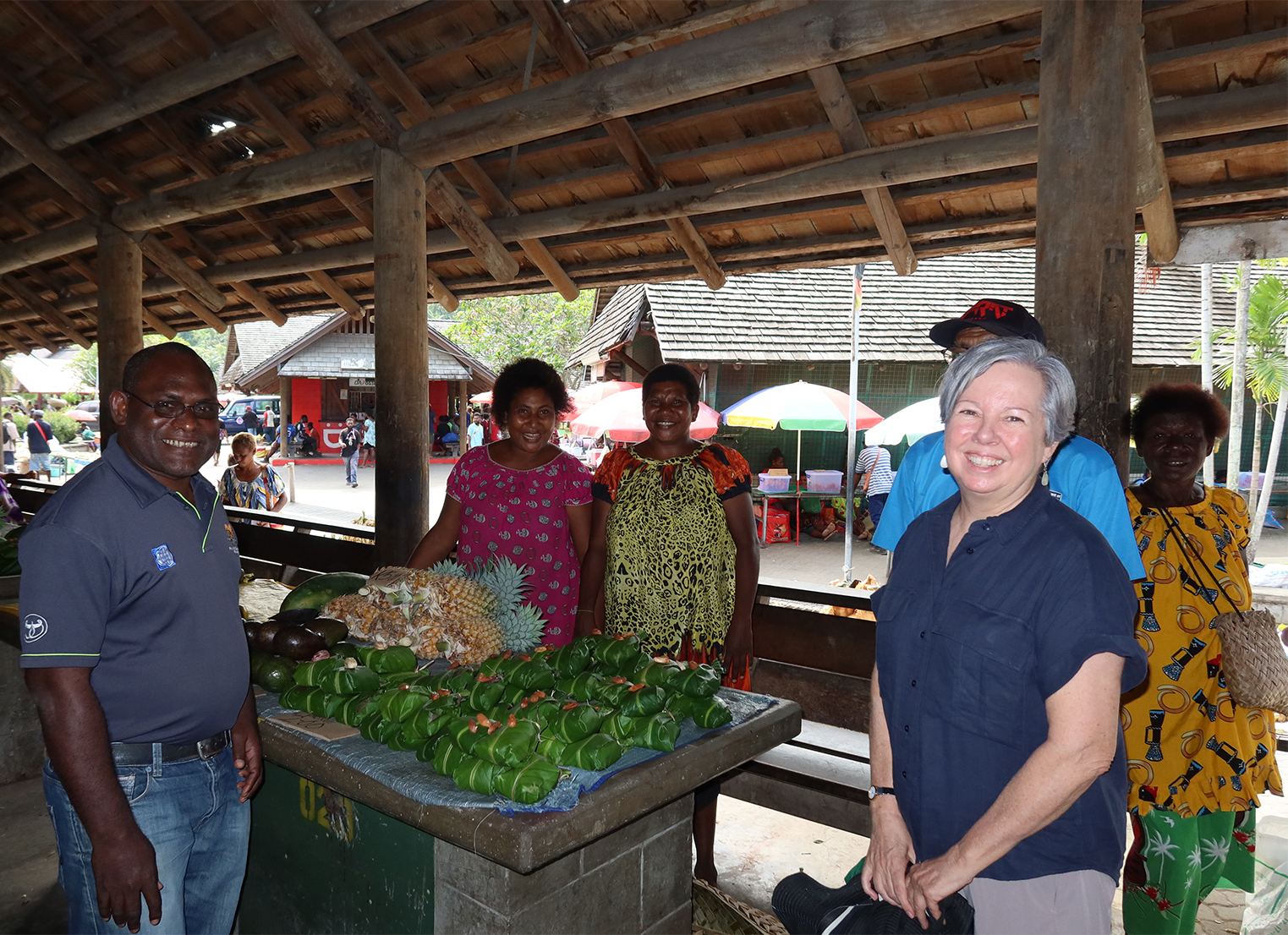
An agricultural ecologist, and Head of the School of Biology and Environmental Science, Professor Wallace’s focus has been to help women in developing countries improve and commercialise their everyday indigenous crops. These crops can provide extra cash to lift their health and education opportunities and provide additional food security when other crops may struggle due to climate change.
A major pinnacle of her career is the almost 20-year project which resulted in commercialisation of the galip nut – a native, tree-grown nut from Papua New Guinea (PNG) that looks and tastes like a soft almond, high in protein, iron, and zinc compared to other nuts.
Funded by the Federal Government’s Australian Centre for International Agricultural Research (ACIAR), in partnership with PNG’s National Agricultural Research Institute (NARI), the project has been led by Professor Wallace from its beginning in 2006.
"Most of the work I do is focused on women and this project has provided an income for women."
“Our research has underpinned the country’s efforts to take a low-value, wild-harvested nut that is mostly consumed in local communities and create an indigenous food product for national and international markets,” Professor Wallace said.
“The galip nut industry is paving the way for the many other PNG indigenous foods that have great potential to be commercialised.”
The project has taken the galip nut, traditionally grown for family use by women on trees close to their village, to a dry-roasted, packed product that rapidly sells out in PNG supermarkets.
The little nut that could
Thanks to expert agricultural knowhow and brilliant marketing, this once humble nut has reached gourmet heights in Port Moresby’s Port Terrace Restaurant & Bar where the head chef uses them in place of pine nuts in pesto or to crust a piece of salmon.
“Galip nut snacks have also won major awards at the SIAL Food Innovation show in Paris,” Professor Wallace said.
“I am particularly proud of this project because we created a whole new industry from the ground up and there are few examples of this in the world.
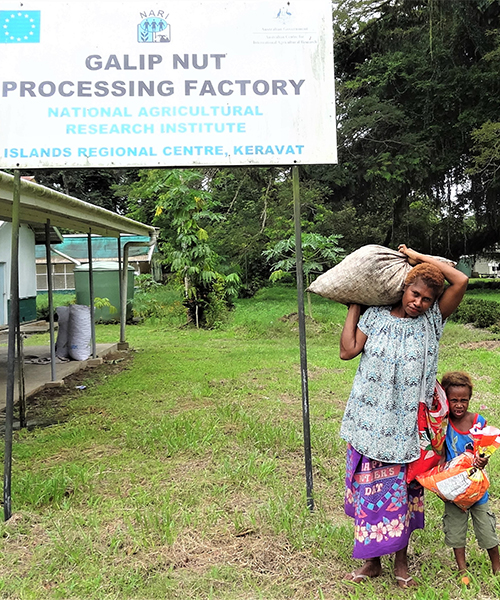
“Most of the work I do is focused on women and this project has provided an income for women who ‘own’ the galip trees planted by their mothers and grandmothers.
“Although the trees were important in traditional culture, and women have had relationships with their trees across maternal lines, our first, and one of the most difficult, task was to change the mindset of the local people that did not value indigenous foods.
“The galip trees planted around villages have bigger nuts than those in the forest because people have been choosing the best ones to plant and cultivate for generations.
“Some women might sell a few fresh nuts wrapped in banana leaf at the market.
“Even so, it was hard to convince commercial players that there was a market for high-value packaged galip nuts."
Professor Wallace said many research trials, from cracking open the nuts (using a hand-operated device for opening macadamia nuts) to finding the exact drying conditions to maintain freshness and shelf life, were needed to establish a process for a commercial product.
“Once this was done ACIAR funded a large commercial trial to make some product and see if it would sell.
“That was an absolute game changer.
“Once we had this packaged product in the supermarket of a locally grown indigenous food that people in PNG knew and understood, they loved it.”
“We did supermarket tastings and the first batches sold out quickly; we couldn’t keep up with demand. People were so proud to see their own food on the supermarket shelves. That basically inspired other people to say, ‘Hey I’m going to put my money on the table and invest in this.’
“We now have about 2000 small growers and three locally owned companies drying and packaging them. Galip was the forerunner. It has opened people’s minds and opened markets.”
In all her projects, Professor Wallace has worked across disciplines.
“We have social scientists, experts from business and marketing, agriculture and food scientists. On this project they had different perspectives on where and how the small holders should sell their produce to get payment.”
Kokoda’s okari nut to follow galip success
Now a blueprint for the commercialisation of indigenous produce, the galip nut project has inspired more entrepreneurial ventures.
“My Griffith University colleague Associate Professor Shahla Hosseini-Bai is working in the Kokoda region where they are training women to dry and process okari nuts to sell to trekkers on the track, and as souvenirs to take home.
“Indigenous foods around the world have so much potential. I’ve done similar work in Vanuatu, Solomon Islands and Fiji as well. Indigenous foods are good for climate change, they conserve biodiversity, trees can sequester carbon and help hold the soil in place.
“So turning them into food crops, it's basically diversifying our food systems and making them safer from climate change, because if your sweet potato fails, then hey, go and eat the galip or okari nuts.”
Professor Wallace’s work has garnered interest from FAO (Food and Agriculture Organisation) which is looking at how to diversity food systems to make our food sources more resilient.
“Indigenous foods around the world have so much potential.”
“I have been talking with the FAO, they see the benefit of this approach for many countries, because there are always indigenous foods that have not been recognised, that have not been commercialised.”
With the satisfaction of knowing the 20-year project has had an outsized positive impact on people and the planet and the galip nut‘s future safely in the hands of PNG’s people, Professor Wallace is looking forward to the next challenge.
“If another project comes up in PNG, I’ll be there in a heartbeat.”

We believe in the free flow of information
Republish our articles for free, online or in print, under Creative Commons licence.

Republish
You are free to republish the text of this article both online and in print.
We ask you follow some simple guidelines.
Images are not included in this blanket licence as in some cases we are not the copyright owner.
Do not edit the piece, ensure you attribute the author and mention the article was originally published on Real Focus.
By copying the HTML below, you will be adhering to all our guidelines.
Copy this HTML into your CMS.Press ⌘C or CTRL+C to copy.
Latest stories

16 October 2026
Some Australian research funding is now a lottery. And that’s actually good news
Professor Adrian Barnett from QUT and Professor Philip Clarke from The University of Melbourne explain why leaving some funding decisions up to luck can save everybody time and effort – and help understand what the funding actually does.
Read more of Some Australian research funding is now a lottery. And that’s actually good news

7 October 2026
It’s true, Australia won’t ban ‘sock puppet’ accounts on social media. Here’s why
Professor Daniel Angus and Associate Professor Timothy Graham from the QUT Digital Media Research Centre explain how Australia's proposed Digital Duty of Care bill will protect university researchers using fictitious accounts for online safety research.
Read more of It’s true, Australia won’t ban ‘sock puppet’ accounts on social media. Here’s why
25 September 2026
An AI model has found a new ‘CRISPR‑like’ biological system. Here’s what it means for science
AI agents may become another tool for researchers and even transform biological research, but there are also questions around how the technology can be kept safe, writes Associate Professor Dimitri Perrin, Co-Director of the QUT Centre for Data Science.