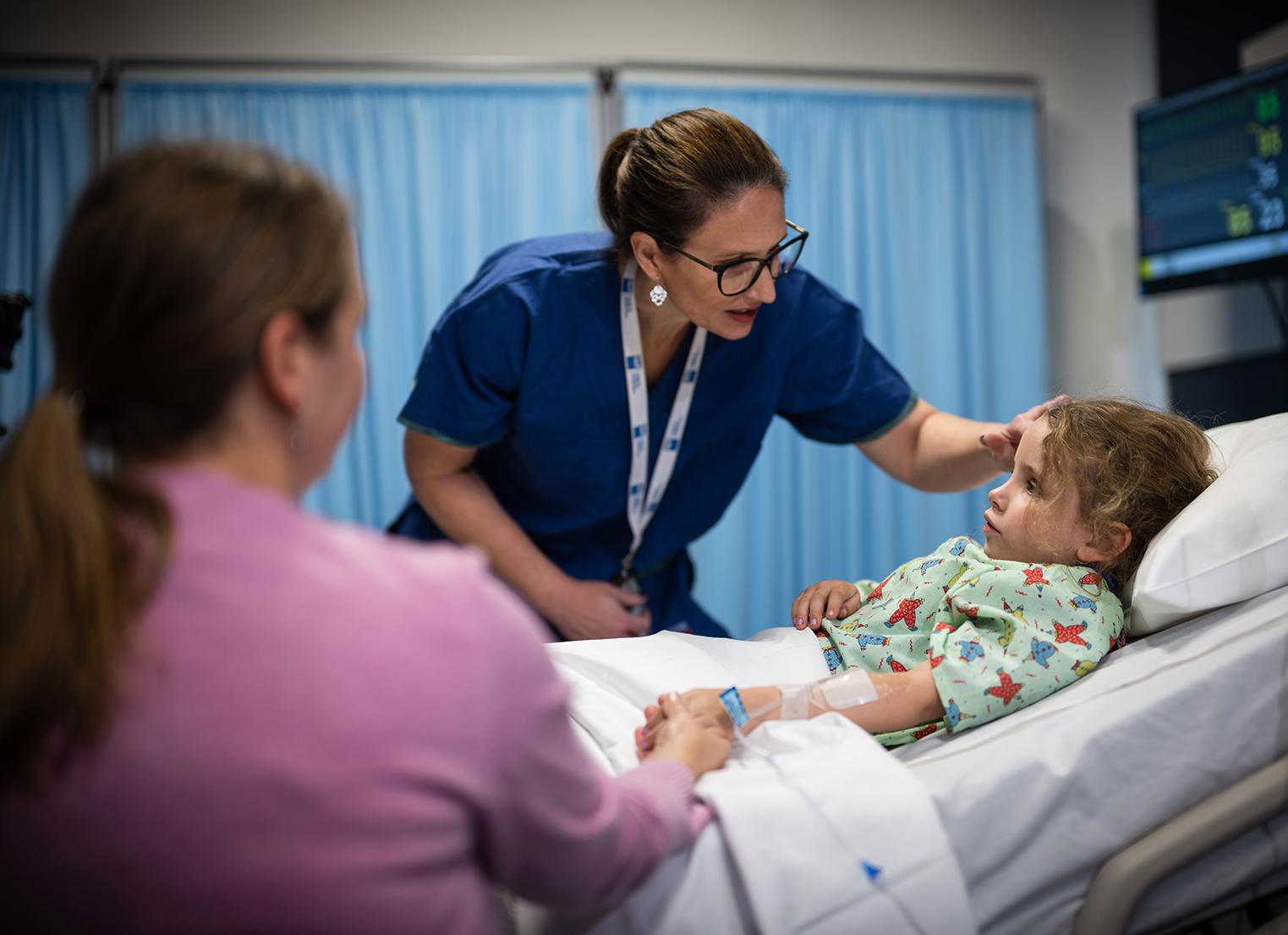
Each year in Australia, thousands of children are rushed into paediatric intensive care units (PICU) for life-threatening illness or injury. The medical care is world-class. Teams of doctors, nurses, and specialists work with advanced technologies and around-the-clock vigilance to save lives. And most children survive.
But Professor Debbie Long has always known that survival is only part of the story.
For more than 20 years, Professor Long worked as a PICU nurse, standing alongside families in some of the most difficult moments they would ever face.
She saw the trauma, the fear, heartbreak, and exhaustion that came with the sudden, high-stakes environment of intensive care.
She also saw what came next.
“So often, I’d see families walk out of the PICU and straight into a second, quieter crisis,” she said.
“No one was watching anymore, but they were still struggling.”
Some children bounced back quickly. Others faced months or even years of developmental delays, emotional distress, or behavioural challenges – including the risk of PTSD (post-traumatic stress disorder).
Parents were often carrying their own psychological scars – anxiety, depression, or PTSD – all while trying to care for a recovering child.
Yet, once the hospital stay ended, most families were left to navigate this complex recovery alone.
From the bedside to research
Now with the QUT School of Nursing and QUT Centre for Healthcare Transformation, Professor Long leads one of Australia’s few dedicated programs exploring what happens after PICU.
Her work looks beyond the hospital walls – into homes, schools, and communities – to understand the long-term impacts of critical illness on children and families.
“Post-intensive care syndrome in children is real,” she said.
“One in three children develops new or worsened health problems after PICU. And families are affected too – often profoundly.”
Professor Long’s approach blends evidence with empathy.
She works in partnership with families, clinicians, and researchers across the country to co-design solutions that are practical, compassionate, and grounded in the real experiences of those they aim to support.
In 2018, Professor Long was awarded a Churchill Fellowship to study international models of PICU follow-up care.
She visited centres in North America and Canada, finding systems where ongoing monitoring, developmental screening, and emotional support were part of standard care.
What she learned confirmed what she had long suspected: recovery doesn’t end at discharge. Systems can, and must, be built to support families after discharge, not just during hospitalisation.
“We put so much energy into saving lives in the PICU … But if we don’t also support what comes next, we risk losing something else – quality of life, developmental potential, the emotional wellbeing of the whole family,” she said.
Transforming follow-up care
Professor Long is now involved in multiple large-scale projects that are transforming follow-up care.
She is leading a national, multi-site clinical trial, funded by the Medical Research Future Fund (MRFF), that is using early psychosocial intervention to reduce trauma symptoms in young children and their parents after a PICU stay.
Co-developed with Children’s Health Queensland, it is informed by years of research on medical traumatic stress and involves QUT collaborators Professor Samantha Keogh, Associate Professor Zephanie Tyack, and Associate Professor Hannah Carter.
“Children admitted to the PICU are exposed to potentially traumatising situations such as painful procedures, separation from parents, unfamiliar surroundings, sights and routines, and cognitive impairment due to sedating medications,” Professor Long said.
“The PICU-CARE Trauma Resilience Intervention is a brief, targeted early intervention for young PICU children identified as ‘high risk’ for developing PTSD.
“It will be delivered via telehealth to ensure that all children at high risk can benefit from this novel care.”
The project will investigate and evaluate if this early targeted intervention, compared to standard care, reduces PTSD in PICU survivors.
Professor Long is also partnering with the Queensland Paediatric Sepsis Program to design a state-wide post-sepsis model of care.
This NHMRC-funded research unites Sepsis Australia, the Queensland Family and Child Commission, Clinical Excellence Queensland, and Health Translation Queensland to ensure that recovery models of care reach children and families, no matter where they live.
And in collaboration with the Australia and New Zealand Intensive Care Society (ANZICS), Professor Long is co-leading the development and implementation of the first-ever binational parent-reported outcome measure for paediatric intensive care.
Supported by the Intensive Care Foundation, this initiative will give visibility to the longer-term wellbeing of survivors.
It will use ANZICS Registry data from all ICU admissions across Australia and New Zealand to help identify variations in practice, guide targeted interventions, and inform evidence-based improvements in PICU outcomes.
“We’ve spent decades measuring whether children survive intensive care,” Professor Long said.
“Now we can finally ask – but how are they doing, and how can we improve the care we provide to them and their families? That question is what drives everything I do.”
Professor Long said no family should feel forgotten once a health crisis has passed, and every child should have the chance to recover not just physically, but fully.
“The story of paediatric intensive care doesn’t end when the ventilator is turned off or the monitors go silent – it continues for years to come,” she said.
“We want more of these stories to be ones of resilience, support, and thriving futures.”

We believe in the free flow of information
Republish our articles for free, online or in print, under Creative Commons licence.

Republish
You are free to republish the text of this article both online and in print.
We ask you follow some simple guidelines.
Images are not included in this blanket licence as in some cases we are not the copyright owner.
Do not edit the piece, ensure you attribute the author and mention the article was originally published on Real Focus.
By copying the HTML below, you will be adhering to all our guidelines.
Copy this HTML into your CMS.Press ⌘C or CTRL+C to copy.
Latest stories

16 October 2026
Some Australian research funding is now a lottery. And that’s actually good news
Professor Adrian Barnett from QUT and Professor Philip Clarke from The University of Melbourne explain why leaving some funding decisions up to luck can save everybody time and effort – and help understand what the funding actually does.
Read more of Some Australian research funding is now a lottery. And that’s actually good news

7 October 2026
It’s true, Australia won’t ban ‘sock puppet’ accounts on social media. Here’s why
Professor Daniel Angus and Associate Professor Timothy Graham from the QUT Digital Media Research Centre explain how Australia's proposed Digital Duty of Care bill will protect university researchers using fictitious accounts for online safety research.
Read more of It’s true, Australia won’t ban ‘sock puppet’ accounts on social media. Here’s why
25 September 2026
An AI model has found a new ‘CRISPR‑like’ biological system. Here’s what it means for science
AI agents may become another tool for researchers and even transform biological research, but there are also questions around how the technology can be kept safe, writes Associate Professor Dimitri Perrin, Co-Director of the QUT Centre for Data Science.