
Associate Professor Naomi Barnes, QUT School of Education
Every crisis creates pressure for action. Whether the issue is housing affordability, cost of living, artificial intelligence, social cohesion, climate adaption or something else, public expectations demand policy leadership acts. People want their leaders to clearly identify the problem and announce a solution. There is an innate desire for stability that assumes a carefully and logically crafted policy will make a significant difference to uncertainty.
Unfortunately, the challenges of our time rarely fit this model.
We are increasingly confronted with what academics and commentators describe as a polycrisis or permacrisis. This is a condition where multiple social, economic, political and environmental pressures overlap and interact. Problems cannot be isolated and surgically removed. The outcome of such action is sometimes worse than the original crisis. Because crises are interconnected the consequences are difficult to predict, the decisions are under pressure from competing values. Basically, policy work in times of crisis can draw on very little in the way of clear-cut answers.
The future of governing must include policy leadership; decision making that demonstrates a capability for exercising judgement, not simply applying technical solutions from a limited repertoire of processes.
Until now, the belief that more information will lead to better judgements has dominated how decisions are made about social challenges. It makes sense – gather the evidence, identify the best practice through data about what works and what does not, and apply the solution. This approach has achieved enormous progress and evidence-informed policy making remains essential.
Current challenges, however, are revealing the limits of these technical approaches and the quality of the evidence informing policy.
The question behind the question
Sliding literacy and numeracy scores are not simply an education question. They are also questions about social equity, family stability, community resources, digital media access and consumption, teacher workforce pressures, health and wellbeing, and the kinds of societies we imagine for young people. Housing is not just an economic uncertainty; it is a social equity, community wellbeing and environmental sustainability uncertainty. Artificial intelligence is not merely technological. It raises concerns about employment, responsibility, creativity and power. Climate adaption needs more than engineering and infrastructure. It requires decisions about whose interests are prioritised, what risks are acceptable and what future a community wants to build.
These are questions of judgement.
This is why policy decision-makers must have interdisciplinary knowledge to know not just how the crisis looks now, but where it has come from, what is shaping it and what diverse solutions are possible.
Problems are experienced locally, long before they are measured systematically.
Policy work is not about the implementation and enactment of solutions. Policy begins much earlier. Before a government can solve a problem, it must decide what kind of problem it is. Is youth crime primarily a policing issue, a social issue, an economic issue, an educational issue? Is declining trust in institutions a communication problem or a governance issue? Chances are it is something much deeper.
The challenge for policy makers is how the problem is defined influences what solutions are made possible.
Because contemporary governance operated in increasing uncertainty, the natural response is to look around the world for solutions. The Australian government has looked to international organisations, think tanks with global syndication, advocacy groups and professional networks with worldwide oversight and experiences across jurisdictions. This circulation of knowledge is valuable. Societies should learn from each other. But this creates a belief that social problems can be understood through comparison, measurement and transfer from one jurisdiction to another.
But problems are experienced locally, long before they are measured systematically.
The view from the ground
To do this is to govern from a distance. The further policy actors are removed from the everyday realities of a crisis, the more likely they see abstract categories for intervention. What looks like a literacy crisis, an attendance crisis or a productivity crisis from afar may look very different to the communities living it. Observing a phenomenon is very different from understanding it.
Besides, no amount of information, no matter how valuable, can remove the need for judgement.
Best practice can tell us what worked well before. It cannot tell us what should be done when circumstances are unprecedented, values are in conflict or futures remain uncertain. A policy that succeeds in one community may not succeed in another. A solution designed for one problem may create unintended consequences elsewhere.
The task of contemporary policy makers is recognising the limits of expertise, not abandoning it.
Ancient philosophers described this capacity as phronesis, or practical wisdom: the ability to make sound judgements when rules alone are insufficient. It involves understanding context, weighing competing considerations and acting responsibly when there is no perfect answer.
At a time when public policy is focused on artificial intelligence, this may seem old-fashioned. But the central problem facing democratic societies has changed very little. Technologies of governance come and go. New systems promise greater efficiencies and more accurate predictions with better data. But they cannot determine what societies value, what trade-offs are acceptable or what responsibility we owe each other.
These decisions are human.
About the researcher
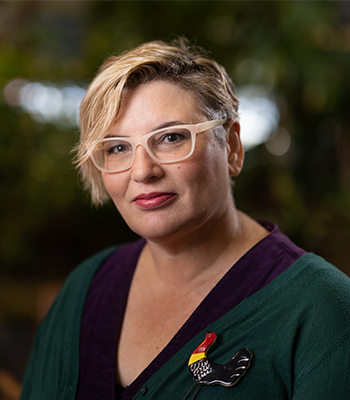
Associate Professor Naomi Barnes is a researcher from the QUT School of Education and QUT Centre for Justice interested in how political actors perform and respond to crises.
With a specific focus on moral panics, she has focused on education politics in Australia, the US and the UK.
Professor Barnes is regularly asked to comment on how Australian teachers should respond to perceived threats to Australian nationalism, identity, and democracy.
About the artwork
The Escher cube (or impossible cube), depicted in the illustration by QUT Bachelor of Design graduate Lucy Schramm, is a metaphor for how certain problems may appear simple at first glance (a straightforward cube, as depicted on the left), then impossible upon closer inspection (the impossible cube in the centre), then understood in their complexity when observed from a new perspective (the question marks emerging from the cubes on the right).
QUT Bachelor of Arts
Technology is reshaping how we live and work. At the same time, culture, ethics and communities are shaping how technology evolves. The biggest challenges of our time sit where these forces meet.
The new Bachelor of Arts at QUT is designed for that intersection. As a university of technology, QUT brings a distinctive perspective to the humanities, combining critical thinking with digital capability, research expertise with real-world application, and creative insight with industry awareness.
Study public and social policy to shape fairer communities and influence decisions across government, NGOs and social services with the Bachelor of Arts (Public and Social Policy).

We believe in the free flow of information
Republish our articles for free, online or in print, under Creative Commons licence.

Republish
You are free to republish the text of this article both online and in print.
We ask you follow some simple guidelines.
Images are not included in this blanket licence as in some cases we are not the copyright owner.
Do not edit the piece, ensure you attribute the author and mention the article was originally published on Real Focus.
By copying the HTML below, you will be adhering to all our guidelines.
Copy this HTML into your CMS.Press ⌘C or CTRL+C to copy.
Latest stories

16 October 2026
Some Australian research funding is now a lottery. And that’s actually good news
Professor Adrian Barnett from QUT and Professor Philip Clarke from The University of Melbourne explain why leaving some funding decisions up to luck can save everybody time and effort – and help understand what the funding actually does.
Read more of Some Australian research funding is now a lottery. And that’s actually good news

7 October 2026
It’s true, Australia won’t ban ‘sock puppet’ accounts on social media. Here’s why
Professor Daniel Angus and Associate Professor Timothy Graham from the QUT Digital Media Research Centre explain how Australia's proposed Digital Duty of Care bill will protect university researchers using fictitious accounts for online safety research.
Read more of It’s true, Australia won’t ban ‘sock puppet’ accounts on social media. Here’s why

25 September 2026
An AI model has found a new ‘CRISPR‑like’ biological system. Here’s what it means for science
AI agents may become another tool for researchers and even transform biological research, but there are also questions around how the technology can be kept safe, writes Associate Professor Dimitri Perrin, Co-Director of the QUT Centre for Data Science.